


The Cowboy: Mythic Hero and Maligned Herder
Daniel Miller | Montana, United States
Photographer: Daniel Miller
Exhibit Title: The Cowboy: Mythic Hero and Maligned Herder
Location: Montana, United States
The American cowboy remains a mythic icon for millions of people worldwide. Their perceptions of the cowboy are based mostly on movies made in Hollywood. Blue jeans are bought by urban consumers who have never been near a cow or horse, yet identify the clothes they wear with freedom and wide open spaces and the cowboy way of life. The image of the cowboy was even used to create one of the most successful corporate advertising campaigns ever -- for Marlboro cigarettes. Despite this popularity, the life of the working cowboy remains woefully misunderstood. There is a mistaken belief that real cowboys no longer exist. The fact is that working cowboys and cowgirls are still found throughout the American West, caring for the land and animals and keeping rural communities connected and vibrant. And they use the word "cowboy" as a verb as well as a noun.
Growing up on a dairy farm in Minnesota in the early 1950's, my heroes were "cowboys" like Roy Rogers, Gene Autry and the Lone Ranger. Some of my earliest memories are of riding horses. As a kid, one of my favorite books to read was the cowboy classic, Smoky: The Cow Horse, by Will James and, like many boys of my generation, I dreamed of being a cowboy someday.
After four years working with Tibetan-speaking nomads in Nepal as a Peace Corps Volunteer in the 1970s, where I frst developed an interest in anthropology and photography, I went to Montana to work as a cowboy, fulfilling a boyhood ambition. At the time, I believed that practical skills and knowledge I would be able to acquire cowboying would be useful for livestock development work I hoped to be able to do with nomads in Tibet.
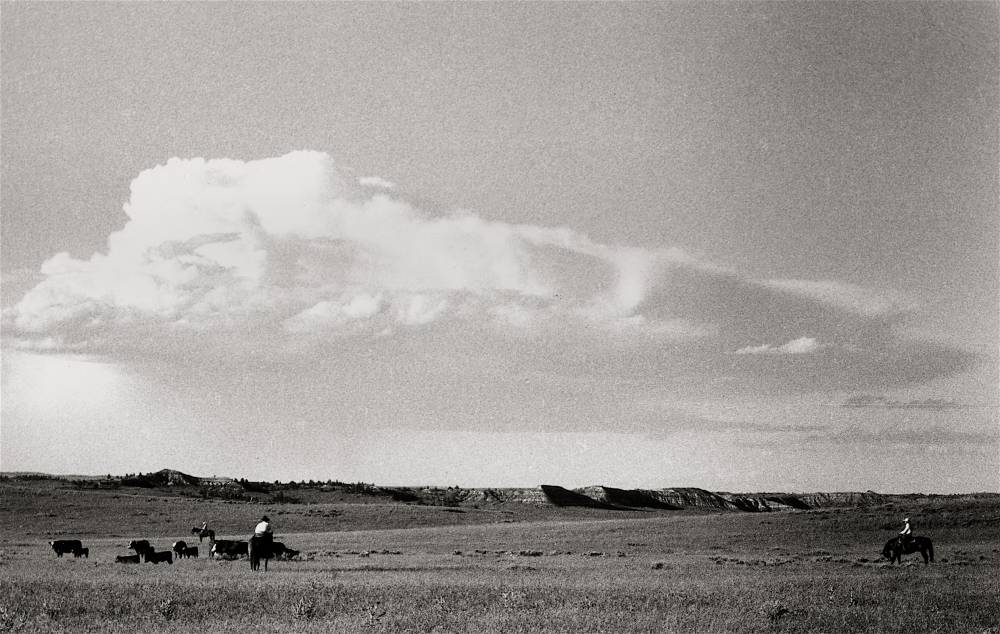
The images in this exhibit are from 1982-1986 when I cowboyed on the Padlock Ranch in Montana. I was not there as a photographer or anthropologist documenting ranching communities, but actually working as a cowboy and a member of a unique group of people who took considerable pride in what they did for a living and were concerned for, and closely connected to, the rangeland environment. As such, many of these photographs may not have the technical and artistic qualities I would have hoped for as they were captured in brief moments while on roundup waiting for a branding iron to get hot, or snapped in a hurry just prior to mounting my horse. All of the images are BD (before digital) and on black and white 35mm film, taken with a manual Canon camera. For this exhibit, black and white prints were scanned and made into jpeg files for uploading. Some were slightly digitally enhanced to adjust the contrast and lighting.
Living and working in Asia for much of the last twenty years, I am surprised at times how the American cowboy continues to be seen as a legendary figure for so many people, including Americans I meet. The cowboy's real role as a highly skilled livestock specialist and rangeland manager is seldom well understood or appreciated. Adored for their ostensible independence, the sense of community that cowboys and ranchers possess is not well known. Famous for their tough character, cowboy's empathy for animals and respect for the land is also not well recognized. One widespread view of cowboys that I'm pleased to acknowledge is generally true is their chivalry. The overwhelming majority of cowboys I have had the pleasure to work with have been polite, gracious and courteous. Many of them also possess amazing gallantry. It takes real daring to ride at a full gallop across sagebrush flats in pursuit of a cow to rope in order to doctor it for foot rot, especially when you are alone on the prairie.
These photographs are a simple endeavor aimed at providing a little more insight into, and understanding of, a remarkable rural community in America and a group of people that continue to take pride in a job well done, often for very little pay. Men, women and children who derive simple pleasures from riding a good horse across the prairie as the sun comes up in the morning, the smell of fresh-cut alfalfa, and watching the sunset in the evenng as coyotes sing in the hills.
With globalization, cowboys and ranchers in the American West face increasing social, economc and environmental challenges. How they adjust to the changes taking place has importnat implications for rural communities and for American culture. I'm confident that as long as there are cows there will be cowboys and cowgirls taking care of them and the rangelands and the world will be better off for it.
tibethand108@hotmail.com

Make Comment/View Comments