

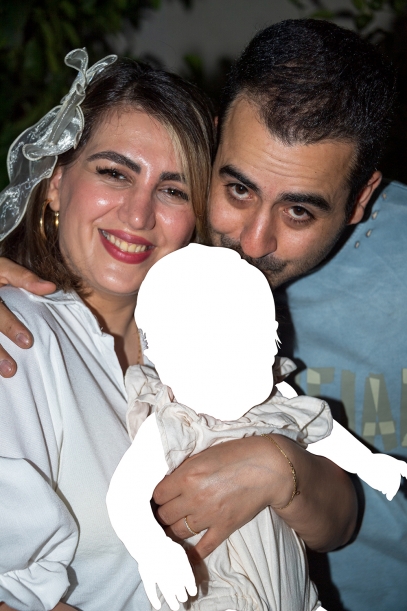

The Unseen, a systemic violence without spectacle.
Photographer: Aljohara Jeje
Exhibit Title: The Unseen, a systemic violence without spectacle.
Location: Iran
This series was developed during a recent artist residency in Iran. While documenting street scenes, slowly a recurring absence became apparent: no mothers with babies, pavements without strollers, and squares without running small people: children were largely missing. This absence reflects the long-term effects of sanctions with prolonged economic uncertainty and persistent inflation since 1979, making marriage and parenthood increasingly an unaffordable luxury.
While news media extensively documents the economic and political effects of sanctions, focusing heavily on inflation, currency shifts, and geopolitical tensions, the long-term, exponential disappearance of children from Iran is almost entirely confined to scientific papers and demographic statistics.
Near Imam-Zadeh-Saleh-Mosque in Tehran, beside the bustling Tajrish Bazaar, a statue of children, entirely in white, triggered the concept: absence cannot be photographed directly, but can be made visible. Children in my photographs are rendered as white silhouettes to expose, not to conceal: a quiet crisis without spectacle, yet unmistakably alarmingly perceptible present, creating a society without children’s laughter.
Visualising this absence, is to bring attention to the profound, long-term inhuman consequences of political pressure and (US-led) sanctions.
Artist / Photographer: Aljohara Jeje
Location: Iran
Post-production intervention: children replaced by white silhouettes (no AI generation)
My work is driven by an exploration of the complex and multifaceted nature of the human experience. A thought becomes a thread, develops into an idea, crystallises into a theme, and through a wide range of skills is rendered visible. Symbolic intervention is not decoration but a method: a way to examine cultural values, historical narratives, and contemporary power structures. Art is a universal language. It knows neither borders nor tongues.
The Unseen emerged during a recent three-month artist residency in Iran. While photographing daily street scenes, a recurring absence became impossible to ignore. Shopping malls were without mothers with babies. Pavements were without strollers. Public squares were without running toddlers. Children, in general, were largely missing from public life. The phenomenon was so persistent that it ceased to feel anecdotal and revealed itself as structural.
In front of the Imam Zadeh Saleh Mosque in Tehran, beside the Tajrish Bazaar, a statue of a boy and a girl, entirely in white, became a turning point. It celebrated childhood precisely where childhood seemed to be withdrawing. It offered an unsettling clarity: absence could not be photographed directly, but it could be made visible.
Sanctions and political pressure are widely described through inflation, currency collapse, and the erosion of the middle class. What is rarely articulated is their slow demographic consequence: the long-term erosion of family formation, and the disappearance of childhood from everyday life. Because absence resists documentation, the series adopts a deliberate visual intervention. Children are rendered as white silhouettes, consistently across the work. This is not concealment, nor protective pixelation. It is a conceptual act: to make what is missing insistently present, and to position absence as evidence.
Living and working across different cultural environments has shaped my attention to how societal constructs and prejudices are formed, defended, and potentially broken. The Unseen invites viewers to look at what is no longer visible, and to recognise in that disappearance a form of systemic violence that leaves no ruins, only emptier streets.
VoxDev (London School of Economics network) — “How sanctions eroded Iran’s middle class” (research explainer by Farzanegan & Habibi, 5 days ago). Directly ties sanctions to middle-class collapse using synthetic-control methods. VoxDev: https://voxdev.org/topic/institutions-political-economy/how-sanctions-eroded-irans-middle-class
Al Jazeera (Opinion) — “Guess who the Western sanctions on Iran have crippled? The middle class” (Farzanegan & Habibi, Sep 28, 2025). An op-ed translating the research into plain language about social stability. Al Jazeera: https://www.aljazeera.com/opinions/2025/9/28/sanctions-on-iran-have-been-a-spectacular-strategic-failure-for-the-west
Economic Research Forum (ERF Forum) — “Sanctions and the shrinking size of Iran’s middle class” (Nader Habibi, Sep 30, 2025). Policy-oriented summary stressing social repercussions. https://theforum.erf.org.eg/2025/09/30/sanctions-and-the-shrinking-size-of-irans-middle-class/
theforum.erf.org.eg +1 The Economist — “Inside Iran’s war economy” (Jul 3, 2025). Broader macro piece; notes soaring prices/unemployment and the social strain on ordinary Iranians, implicitly the middle class. The Economist: https://www.economist.com/finance-and-economics/2025/07/03/inside-irans-war-economy
Atlantic Council (policy report) — The Future of US Strategy Toward Iran (Oct 3, 2024). Explicitly says decades of sanctions strengthened the regime and weakened the globally-minded middle class/private sector. Atlantic Council: https://www.atlanticcouncil.org/wp-content/uploads/2024/10/The-future-of-US-strategy-toward-Iran.pdf
Chatham House (multiple 2025 outputs) — Sanctions analyses that discuss unintended societal impacts and how sanctions entrench alternative power networks inside Iran. https://www.chathamhouse.org/2025/07/understanding-and-improving-sanctions-today
CNN https://edition.cnn.com/2025/10/19/middleeast/how-western-sanctions-iran-hurt-middle-class-intl
FORWARD (Foundation for Women’s Health Research and Development):
www.forwarduk.org.uk/about-us/?utm
https://www.aljohara-jeje.com/
Email: Aljohara.Jewel@gmail.comWhatsapp: +966561230511
White silhouettes function as visual evidence of absence. They do not conceal identity but make disappearance visible.Children were removed in post-production and replaced with white silhouettes. This intervention is applied consistently across the series to visualise absence. No AI generation was used.
Make Comment/View Comments