

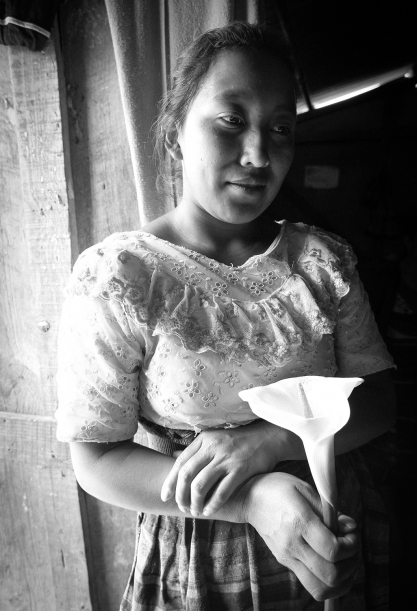

POEMS I BROUGHT DOWN FROM THE MOUNTAIN | Maya of the Guatemalan Highlands
Photographer: Cory Zimmerman
Exhibit Title: POEMS I BROUGHT DOWN FROM THE MOUNTAIN | Maya of the Guatemalan Highlands
Location: Guatemala
I'm drawn to these places where the past resonates and connections unfold, places unpaved, where I can look back to see the path I've traveled.
Arriving at the last home in the village, I exchange glances of gratitude with an entire family living in little more than a cattle shed. Despite enduring genocide, displacement, and unimaginable discrimination, resilience thrives on dirt floors. The Maya of Guatemala communicate through the eyes, revealing dreams hidden within.
After taking a dozen portraits, we gather by the wood stove, sharing tortillas and boiled eggs. I imagine immersing myself in simplicity, yet I know I must leave the warmth and step outside into the mist, feeling the weight of an ancient legacy.
Before descending the mountain, I turn back to see a child with gleaming gold teeth and a broad smile. She seems to yearn for recognition, as if disappearing from sight would feel akin to death. Raising my camera, I worry her weary eyes might be perceived through a lens of pity. As she waves goodbye, a fading silhouette, a dream—as clear day against a backdrop of mist.
In February of 2019, I traveled to the highlands of Guatemala to observe and document those causes of migration and the ongoing efforts to improve living conditions in a specifically troubled region of the Northern Triangle, known as the “Altos.” Through my work with the NGO Feed the Children, based in Guatemala City, I gained insight into the severity of food insecurity and the devastating effects of malnutrition on child development, as well as their dedication to fighting hunger and creating better futures for Maya children and families.
I collaborated with ASSADE, an organization founded by a remarkable woman who survived the genocide, even though her brother, who worked alongside her providing healthcare to the Maya during the war, was killed by the Guatemalan army. In his memory, and with unwavering courage, she continued their mission, establishing ASSADE in the highlands to deliver vital healthcare to the Maya in remote areas, as well as through their clinic in San Andrés Itzapa. Additionally, my journey led me to Priméros Pasos, whose dedicated staff operate a clinic in Xela and extend their services to distant Maya villages.
In the mist-shrouded highlands of Guatemala, the Maya have lived for centuries, with their traditions and language echoing across mountains and valleys. As descendants of one of the world’s great ancient civilizations, the Maya of Guatemala have endured long before the Spanish arrived in the 16th century. They thrived in these lands, building cities, cultivating maize, and charting the stars. Colonization, however, caused disruption—land dispossession, forced labor, and the imposition of foreign rule. Still, the Maya survived, adapting their lives and customs, preserving their languages, and weaving their history into vibrant textiles, rituals, and stories.
But the 20th century brought new challenges. As Guatemala modernized, the Maya remained largely excluded from political and economic power. Tensions over land, inequality, and identity simmered until they erupted into civil war in 1960—a conflict that would last 36 years. During the darkest of times, the Maya suffered immensely. The Guatemalan military, driven by fear and prejudice, targeted Maya communities in a campaign of violence now recognized as genocide. Villages were razed, families shattered, and one to two hundred thousand Maya lost their lives or were displaced (though some claim the death toll could be in the millions).
Yet, in the aftermath of war, the Maya endured, though the decades since the signing of the peace agreement in 1996 have brought new challenges—poverty, discrimination, and the pursuit of justice—but also resilience, revival, and hope. Across the highlands, Maya communities continue to honor their ancestors, celebrate their languages, and assert their rights. Their lives today are marked by both continuity and change: ancient rituals coexist with cell phones, traditional dress with modern education, and old wounds with new dreams.
To this day, both NGOs continue to provide comprehensive healthcare through a participatory model, alongside their ongoing efforts to ensure that healthcare is not a privilege, but a right for all. This remains their everyday mission.
“Many years have passed, bringing numerous changes and challenges,” my friend Julio from ASSADE recently told me, “The pandemic was a significant milestone for both our work and our lives. It set us back... but also taught us great lessons about how everything is interconnected, which I believe is transforming us. This project represents our voices—our communities in the highlands—a work that, without it, no one would know what is happening. Speak loudly; this is why my heart is full of joy and hope for your project. Lastly, I´d like to mention that I am proud that my mother is the founder of ASSADE. When she reflects on the genocide and war, she emphasizes that this is how one can turn a tragic event, our grief, into something beautiful and healing. This is our struggle; this is our mission.”
Early each morning, while working in Guatemala, I would find a local cathedral to sit and meditate on my experiences in the country. I had witnessed so much suffering along my journey, from the migrant camps in Mexico to Guatemalan villages, where more children than not had severe brain underdevelopment due to malnutrition. Their faces were covered in scars, and their noses bloodied by the rugged realities of growing up in mountain-top villages, where their families had been forcibly relocated as the government, on behalf of international mining companies, pushed them further and further toward the peak. I’d try to process why women outnumbered men so greatly, as husbands and sons had migrated to the United States in search of work.Women with their own scars worked the dry, cracked earth surrounding their adobe, stick, and steel homes, desperately trying to harvest corn amid a devastating drought.
I’d begun my journey in Guatemala with Feed the Children, based in Guatemala City, which worked in villages throughout the Altos, assisting schools with meal programs and teaching parents how to cultivate gardens, and supplying seeds and tools that would produce more nutrition than maize alone. I moved on to Antigua, where I worked alongside ASSADE, based in San Andrés, which also operated remotely in convents, schools, and villages wherever they could or needed to go to provide healthcare to isolated communities.
Picked up early each morning by motorcycle. I’d ride on the back with my gear as we crossed the active volcano spewing smoke and ash into the dawn sky that divides Antigua and San Andrés Itzapa¾the magnetic field of the mountain strong enough to pull on the gears of a watch, slowing time, as we’d arrive from one world into another, one more ancient, more isolated, more preserved, yet more vulnerable. As the clinic did not open until 9, though families would already be lined up down the block awaiting care, I would walk to the Iglesia San Andrés church a few blocks away. At that early hour, the pews remained silent, minus the clogs of nuns whisking away on early morning chores. Amidst the strong energy of the land and the peace of the sanctuary, I’d sit and try to heal and often write down my thoughts and reflections.
“I am drawn to these places where the world is still real,” I wrote, “where I can feel the past, the connection between things, and the course of events that led to this point; where I can look back and see the journey I’ve traveled—a path that can't be quickly paved over with denial or disillusionment.”
Upon arriving at the last home in the mountaintop village we’d visit that day, I exchanged glances of gratitude with an entire family living in little more than a cattle shed. Despite enduring genocide, displacement, and unimaginable discrimination, resilience thrived upon dirt floors. The Maya of the Guatemalan Highlands communicate through the eyes, revealing unspoken truths hidden within.
After taking a dozen or so portraits, we’d gather by a crackling horno, sharing a stack of hand-slapped tortillas and a half-dozen hard-boiled eggs. I yearned to immerse myself in such simplicity, yet I knew I must eventually leave the warmth and step outside into the fog and haze, feeling the weight of an ancient legacy bearing down upon me.
Descending the mountain, I’d spotted a puma’s kill cached in a lone cacao tree and heard a rustle and turned back to see a girl with gleaming gold teeth within a broad smile step out of the corn stalk. She seemed to yearn to be seen, as if disappearing from sight was akin to death. Raising my camera, I worried her weary eyes might be seen through a lens of pity as she waved me goodbye, a fading silhouette against a backdrop of mist, and a dream as clear as day.
Halfway down the mountain, Julio from ASSADE told me he wanted me to meet someone special, a 17-year-old girl named Yeny. As I sat down with her outside her family’s humble home for an interview, she told me she was only 13 when she started going door-to-door to teach children in her small highland village how to brush their teeth. Recently, she has been providing fluoride treatments, handing out toothbrushes, and teaching children how to brush with a comical pair of false teeth that drew laughter from the kids. She has a box in her family's home with a bottle of aspirin that she distributes to people who show up at her door in pain. Her dream is to be a doctor, and a few days a week, she walks a long trail to the village at the base of the mountain, where she studies medicine. If all goes according to plan, she will graduate this summer with a degree in nursing and be permitted to administer medicine to her village. Although her box currently contains only aspirin, she hopes to receive donated medicines from a local NGO.
Yeny, still a child but already a leader in her community, makes her mother proud. When I ask her how she felt about Yeny's unique ambition to help the people of her village, she smiles broadly as she warms a tall stack of tortillas over the wood stove in the family kitchen. When I ask Yeny if she is proud of herself, she does not understand the concept; she does not see herself as separate from her neighbors and expresses no pride. It is clear that Yeny is simply a human being doing what humans are meant to do: care for one another.
I collaborated with Primero’s Pasos Clinic, based in Xela, in the northwest highlands. There, we’d set out from the clinic each morning, traveling in the back of pickups and often by foot deep into the mountains, also offering remote healthcare, visiting schools, and training villagers how to filter contaminants from their drinking water. Around easter, I was mugged and beaten in Xela by five men right outside the door of my accommodation. Though a bad concussion and three broken ribs didn’t stop me from climbing back into the mountains the next day, it did remind me of the harsh realities of a land that can easily enchant with the high-altitude light softened by the fog.
After many months in the highlands, I descended from the mountains and spent my last 60 days in the lakeside village of Panajachel. I was there to document a local effort to connect Maya women who knit textiles, specifically the woven skirts known as hulpil, with a global fair-trade market. The hulpil is a richly decorated blouse, usually featuring intricate embroidery and patterns unique to each community and region. The village was bustling with expats and tourists, and my time there served as a bridge to the outside world, which I was gradually preparing to reenter.It was on my last full day, before leaving the country, that I heard horrifying news. I immediately went down to the shore of Lake Atitlán. A beautiful young Mayan woman, who had come down from the mountains to work a summer job in Panajachel, had washed up nude on the shore for fishermen to discover.
By noon, burning candles and red roses had replaced her cold, blue body, and accusations began to spread throughout the village, surrounded by a ring of dormant volcanoes. An unholy truth would soon come to light. Her name was Silda. She was 26 years old when, hours after arriving in the village of 16,000, she was kidnapped, taken on a boat, raped, hogtied, and thrown overboard into the abyss of one of the world’s deepest lakes. While impunity is one monster, the fact that police officers were the ones accused was quite another; however, the horrors of femicide remained the same. As I stood over the flickering candles on the rocky shoreline, extinguishing one by one by the ever-changing winds, I thought about how, here in this Northern Triangle nation, just like stray dogs on the streets, the individual Mayan was not steadily recognized by the eyes of the state, leaving me to ask: In a land where being unseen is akin to death, how can you extinguish a flame that was never allowed to burn?
The words of Mayan Poet and philosopher Hunbetz Men, I quote:
“If I destroy you, I destroy myself.
If I honor you, I honor myself.”
The plan was to next travel to Honduras to document the femicide and gang violence that was driving so many people away. However, the early stages of the pandemic hit us, and those plans had to be scrapped. I holed up in Mexico City, feeling just as uncertain about life, the future, or anything else. But fate and a 2024 election would bring the topic of migration back to the forefront on an unprecedented scale. The time was perfect to revive this project. I returned to Guatemala in June 2025 to work on this presentation in the Altos, as I felt that was incredibly important. I also met with Yeny again. Now six years older, she was able to share much more about her life in the highlands and how things had evolved for her.
“Guatemala is a beautiful country rich in culture,” she told me, “...with its traditions, beliefs, diverse neighborhoods, and languages.
“But it's also a country where there is poverty, malnutrition, and a lack of decent education and decent housing. This can be seen everywhere, even in the capital and cities, where governments offer better education, healthcare, and security. The government also provides aid in remote villages, but the truth remains that it has abandoned many hamlets. When the government struggles financially, individual politicians who profit from government funds to become wealthy seem to change their way of thinking. Their actions are then only for their own benefit, and year after year, no government has shown improvement.
“San Andrés Itzapa is now my town. But Panimaquin is my village; it is where I was raised. It is a place where neighbors look out for one another. If a neighbor is going through a loss, illness, or economic need, we help each other. We survive on livestock (cheeses, cottage cheese, and milk). There is a lot of agriculture. We harvest various crops, depending on the type of vegetable. The harvest (cauliflower, broccoli, peas, carrots, corn, beans, radishes, cilantro, avocado, and peach) is for consumption and is taken to distribute sales to the towns or the capital (Guatemala City). In my village, children play in the streets during the day, even in the late afternoon and evening, without fear of something happening. With a minimum interest in studying on the part of parents, children are less likely to have the opportunity, and if the family is very poor, studies are discouraged due to the lack of employment, due to the distance factor from the center, the factor of roads in poor condition, lack of transportation, and lack of a school within walking distance, which is all in all, a bad factor the economy. Also, where adequate nutrition is lacking, it's not clear what the right course of action is.
“For me, being Mayan means Guatemalan pride. I feel blessed to be Mayan and to speak the Kaqchiquel dialect. But regardless of being Mayan or of Spanish descent, there must be equality, and where there isn’t, it’s because of ignorance. Among those of Mayan descent, there are some individuals who lack knowledge about current events, their own beliefs, and the culture and respect that accompany it, partly due to isolation and a lack of opportunities. But many of us have retained a part of what it means to be Mayan. Among us Mayans, some are very high, exalting the power to be intelligent, rising from the most forgotten places, exalting Guatemala, just like those of Spanish descent. But in our society, we still see a lot of discrimination, a lack of empathy, and that's where we see ignorance. And because of this, we suffer from a lack of basic services and education.
“In my family, I have four sisters and two brothers, all of whom have a two-year age difference. When I was still a two-year-old girl, my father emigrated to the state of Texas (USA). For eight years, he worked hard to buy us a house made of blocks and sheets, and to pay off some debts he incurred to pay a so-called "coyote" who took him to Texas. My mother struggled while he was gone, being alone in Guatemala with all of us children. However, she strongly supported my father’s choice. When my father returned, he dedicated himself to farming. We all went with him to the fields, regardless of age. We helped him plant and grow crops (guacoy, broccoli, cauliflower, Brussels sprouts, sweet peas, and spring peas). My sisters, brothers, and I were fortunate to have been given the opportunity to study in elementary school. But when we returned from school, we would have lunch and then meet our parents in the mountains to go to work, until we would return home at 6 p.m. In rainy weather, we covered ourselves with nylon capes. My father made the capes for us. I liked going to the fields. It's very tiring and hard work, and it’s not very well paid, but I would always want to, regardless. And that’s how we grew up. My family attends the Catholic Church. Since I was little, my mother taught us the importance of attending church for the Faith and Hope that exists in the Father, our Creator, and his Son, Jesus Christ.
“Even after finishing primary school (thank God), we still feared not having the opportunity to study further for a basic education. We had to go to the national school in another village, 5 km away. That’s how the three years of basic education went. When we returned from school at 12:30 pm, we wrapped our bags in plastic bags and stayed behind to help in the fields. When we returned from the fields at night, we did our chores. In elementary school, I enjoyed taking drawing classes. I loved drawing. When I was in my final year, my classmates were asking each other what they would like to continue studying after finishing elementary school. They asked me, "What would you like?" and with a shaky voice, I answered something about drawing because I liked it. And I remembered a painter who went to school to do some paintings behind the elementary school wall. I asked her if the career she chose was very expensive, and she replied that it was. My family doesn't have many resources to pursue that dream, and my father wouldn't want me to follow it. A year passed after graduating from elementary school, and I didn't know what to continue studying. I thought about what I enjoy doing. It crossed my mind a lot, until I decided to study a bachelor’s degree in computer science and a nursing course at the same time.
“My brothers and sisters, who finished basic education much earlier than I, saw my family’s poverty and believed that my parents, who were dedicated to agriculture, could no longer support it, so they ventured out on their own. However, when I finished high school, I stayed behind to help my parents in the fields. I liked selling the vegetables my family grew at the town market. I have a friend from high school who one day told me about a job at an association in the town of San Andrés Itzapa. She took me to that place, where I met the ASSADE Association, and I was hired to provide an educational program on tooth brushing. I went around the village, visiting houses to find children applying fluoride to their teeth and brushing them properly, both adults and children. I also helped disseminate information provided by the association, seeking out the neediest families to deliver food supplies, distributing water filters to families in neighborhoods, conducting surveys, investigating the village's drinking water system, provided donations of water purifiers, as well as educational talks on their use with the participation of foreign donors, food donations, and more. We tried to do the impossible, but unfortunately, we weren't able to achieve it. However, I feel happy that I gave my all to help my village and that I had the opportunity to realize I liked helping people in various ways. That's why I continued studying to become a nurse.
“During my year of training to become a nurse, it was a considerable challenge. Classes were held Monday through Friday from 7:00 am to 4:00 pm. On weekends, I worked to support myself financially. These were days of continuous sleepless nights due to work assignments. I didn’t give up until I achieved what at times seemed difficult to accomplish, with grades of 80 to 90. Until I achieved one of my dreams. Then I began to create my resume. I visited three hospitals in my community of Chimaltenango. However, it was in the capital city, five months after graduating as a nurse, that I was called to the Guatemala City Medical Center, Zone 10. To enter, I had to undergo a lengthy process, including meetings, a polygraph test, and knowledge exams. When I was able to enter the hospital, I had to pass two months of probation, rotating shifts. It was quite a challenge, with very tiring shifts, learning new things each shift, meeting new people, new colleagues, and a new environment. But thank God I managed to pass them at the end of the two months. Then I transitioned from rotating to 24-hour shifts every three days, and I was finally issued a hospital uniform. Recently, they moved from working with bedridden patients to the Maternity Ward, where I help deliver babies and care for the mothers. The hours are long, and the commute by bus is 5 to 6 hours each way, depending on weather and traffic. However, I enjoy learning something new every day, among the diverse characters I meet and the various ways of thinking of each patient. I strive to provide the best service, regardless of the language or country from which they come. My goal is to move forward every day and pursue better opportunities. I will always dream of achieving more, just as I have done until now with effort and dedication, and to never lose faith.”
Feed the Children, Guatemala
ASSADE, Guatemala
Primeros Pasos, NGO
Cory Zimmerman
CDMX | Chicago
Cz@czstudio.works
+52 55 4935 7901 MX
+1 908 292 8911 US

Make Comment/View Comments