


Between a Sword & a Wall
Cory Zimmerman | Mexico City, Mexico
Photographer: Cory Zimmerman
Exhibit Title: Between a Sword & a Wall
Location: Mexico City, Mexico
Central America’s Northern Triangle—El Salvador, Guatemala, and Honduras—is among the deadliest regions on earth. Since the 1980s, 85% of Central American immigrants arriving at the US southern border have come from this area. The region is plagued by violent conflicts, systemic corruption, economic disparities, and environmental crises, all of which have fueled massive migration north, particularly since late 2018, as asylum requests skyrocketed. People flee not just violence—personal and direct—but also extreme poverty and starvation, driven by political instability and climate change. US asylum officers’ credible fear screenings found that 82% of women from the Northern Triangle had “a significant possibility of establishing eligibility for asylum or protection under the UN Convention Against Torture Act.” At least half of migrants are asylum-seeking refugees, many unaccompanied minors. The UN estimates over 1.7 million internally displaced people in the region, with thousands more embarking on dangerous journeys north each year, escaping gangs, cartels, and state fragility.
When, in the fall of 2018, the first caravan arrived in Mexico City, tents had already been pitched in a large football arena. Medical services, a kitchen, consoling, clothing donations, and even a mobile dentist office awaited them. A wrestling ring had been erected at the base of the stands for masked luchadores to body slam one another, bringing temporary joy to the hardened faces of the masses of children waiting their turn to bathe in the plastic sinks set up by the porta-potties, which were usually reserved for concert venues.
I’d already been living in Mexico City for some years, so when I caught word of their arrival, I showed up right on time to see a semi-trailer pull up to the curb. Spilling out of the back, amongst a jam-packed crowd of migrants, I watched in shock as a black- skinned boy tumbled to the street, too weak to stand on his own. He was slow to get up, then collapsed again at the curb, clutching a toy racecar in his reedy arm. I approached, kneeled, and handed him a fistful of snacks I had bought on the way to distribute. I was there to help, not only to take pictures. But as I walked away from the boy and into the migrant camp, I couldn’t keep my eye off the viewfinder, as I felt that no one else would believe what I saw unless they saw it themselves—knowing that only migrants and volunteers were here, not the news, not the press, not a camera—just me, and my own. I was in utter shock, and the camera helped create a barrier between me and the level of human suffering I had never personally witnessed before. The large tents were packed with people; the smell of sickness and weakness filled the air and assaulted my senses, lingering for days. Desperation drained my energy, and I felt dizzy. My heart ached and raced with anxiety, and I did my best to stay calm.
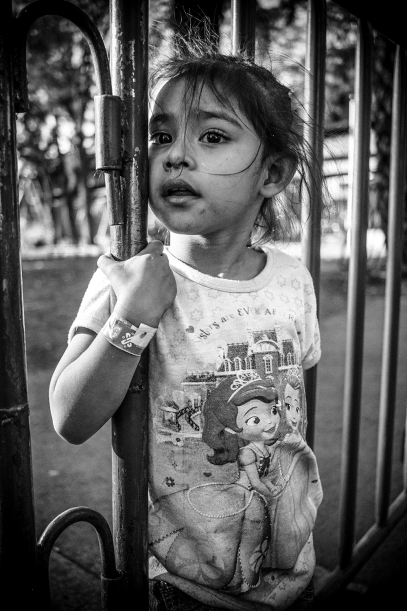
Yet, amid this nightmare, there were smiles. I focused my camera on those faces of joy and hope— young, innocent faces that I felt others needed to see. Among the mothers and fathers, there was determination and hope. What stood out most was that, despite what their children had endured, they played, frolicked in the sun, and watched the luchadores tumbling in the ring with cheers. Children are tough; they can endure. Those are facts, none of which can justify this human tragedy.
I stayed as long as my legs could keep me upright, my body trembling. When the snack bag ran out, I left, determined to return with two large bags the next day. That evening, as I looked through my photos, I couldn’t help but focus on the image of the boy collapsed on the curb, clutching his toy car. There was a look of suffering in his eyes that went beyond any of the others. Of course, everyone looked tired and in pain, but his eyes showed something more severe and urgent. The next day, I decided I was determined to find him. I searched everywhere but couldn’t locate the boy. Finally, after asking around, I learned his name was Johnathan. I went to the medical tent, but the nurses had no record of him. Then I spotted a teenage girl with long, thin braids who looked like she could be his sister, as few of the children there were of African descent. And indeed, she was. She told me Johnathan had been rushed to the hospital that morning.
I left a note with the girl to give to her mother when she returned to the camp. And I went back day after day, but couldn’t find any of the family. Finally, I got a call. It was a woman named Argentina, Johnathan's mother, she explained. I told her I was a photographer and that I had taken photos of her son the day they arrived. I mentioned that I sensed something was wrong and was worried. She started telling me that he was being treated for an undiagnosed case of diabetes, that he’s been malnourished most of his life, and has trouble maintaining weight. The doctors were doing everything they could to prepare him for the nearly 2000 miles they still had to travel, mostly by foot and hitchhiking, aiming to reach the US border. But he needed medication and to eat healthier, and she was scared and unsure what to do. I told her I wanted to help Johnathan and her family in any way I could, and I didn’t think he’d be able to make the journey in his current condition, especially as they were about to cross Mexico’s most dangerous and rural region, far from hospitals or medical care. She was very cautious about accepting my help. She worried I might want something in return, which was very wise of her. She also shared about the horrors many had faced along the way—rape, and worse, if such a thing exists. Basically, she was worried I might be a human trafficker.
The Mexico City shelter had established a moderate level of security by this point because human traffickers had already started arriving, attempting to lure women away from the shelter's protection. It was a real danger. Here and now. On their way to Mexico City, already, 100- 200 people had been kidnapped by the cartel for purposes such as forced prostitution and human slavery. But eventually, I was able to earn Argentina's trust, and she agreed to let me help her and her family, which included Johnathan, who was 7, and her two daughters, aged 11 and 14. Knowing they would risk so much by going on foot, I insisted on buying tickets for a chartered bus that would take migrants who could afford to pay a high price a ride north. I also purchased a large backpack and filled it with food that I hoped would be suitable for Johnathan’s condition, along with socks, hats, gloves, coats, and a large wool blanket. I saw them off as they boarded the bus. But two days later, I received a call. It was Argentina; they were at the hospital in Guadalajara. Johnathan was sick again and receiving more treatment. After we hung up, I didn’t hear from her again, but I was determined to find them. So, I bought a flight to Tijuana.
I stayed in a hostel full of hippies a block from the border crossing and set out on foot through the redlight district, passing some of the roughest streets in Mexico I’ve ever seen, hoping the crude directions I had to the camp were at least somewhat correct. They were not. But with some blind luck, I stumbled upon it. It was a large area right against the border. There was no organization here. No volunteers. No camp per se. A day earlier, I was told, the city had forced them out of a nearby stadium and locked the gates. Now they are holed up in a maze of muddy streets crammed with tents and the debris of living outside—piles of belongings abandoned when they were chased from the camp and moved 45 miles south of the border by bus. What remains looks like a city dump.
The location to which many had been bused lacked both running water and electricity. It seemed the authorities of Mexico, including the mayor of Tijuana, had come under pressure from the Trump Administration and were trying to break their spirit through exhaustion, hunger, and by distancing them from the border in what appeared to be a very strategic move. For those refusing to leave, the sight of the border offered hope. Although they were numerous and starving, they were holding strong, waiting for an opportunity to achieve what they had traveled 2,000 miles for: asylum.
Again, I brought large bags of snacks and every apple I could find at the corner stores along the way, along with my camera. I needed the world to see. I recognized many faces and knew many of the children by now, and it was a bit surreal to see them thousands of miles away. I knew the sweet ones and the brats. The polite ones who wanted to share and who would take me to show me where there were more hungry kids. I knew the ones who loved to eat and would beg for more and more. The picky ones who turned up their noses at strange snacks, and the ones who would eat dirt if they had to, and those who were too lost to eat anything at all. But they were all so beautiful, even in their desperation and exhaustion. By then, they knew me. They would run up to me with smiles.
The adults did their best to keep an eye on their kids, but the children seemed more resilient to the lack of food and nourishment than the adults, who looked exhausted. And their kids were stir-crazy, as driven mad by the limbo. I saw very few other sources of food for the families, let alone the ever-hungry kids, and it haunted me to think I was practically their sole source of the apples they cherished most. Apples, apples, apples, or rather... "Manzana, manzana, manzana," they would shout as they ran up to hug me and play with my hair. "Guero, Guero," which means "blonde" with affection. I had seen many mothers picking lice out of their hair, but I didn’t care. They gave me courage. Those kids were the bravest souls I had ever witnessed, and I would miss them. This neighborhood was one of the shadiest I’ve seen in the world. But I felt much safer among the migrants than I did among the locals. The migrants were good people, and they treated me well. I was very grateful, and they were very thankful for my support and the fruit I had brought their children. They also enjoy talking and having their photo taken, and I wished them the best, though it was obvious all national and international organizations had now abandoned them.
The following day, I saw two men trying to cram a dead migrant with rigor mortis into the back of a make-shift ambulance too short for his legs, so they shouldered the door again and again, trying to break the lock in his knees. I went into a nearby corner store for more apples and snacks. I cleared the shelves, and on my way out, out of the corner of my eye, I saw a familiar face. It was Johnathan, his two sisters, and Argentina. I was very relieved to see them. I immediately gave them all the food, and I took a group photo of them sitting on the curb. But Johnathan did not smile. I could see he was still very ill. Argentina told me that Johnathen was now sick with bronchitis. I gave her money for her phone and told her to call me every day and keep me updated. She told me where her shelter was, as she was staying in one specifically for women and children. I got up early the next morning and walked to the shelter.
I have been to many sketchy places around the world, but the walk to this shelter was one of the scariest moments in my life, at best, post-apocalyptic. This part of Tijuana, just blocks from the US, felt like a lawless war zone. Mountains of garbage were everywhere, with people sleeping on top and snuggled inside. Drug addicts roamed freely, and the mentally ill fought their demons in broad daylight. As I finally reached the shelter, directly across the street from the border wall, the gate to the shelter was closed and locked, but I was able to peek through a hole in the sheet iron, and I saw a large group of tents and a few picnic tables where a few children were being fed. I knocked, but no one came or even looked my way. Later that day, I got a text from Argentina, and she told me that she had missed her appointment for asylum because she had to take Johnathan back to the hospital. I asked her to please go, even though she was late, and to meet me after. She told me with weary eyes that they had told her she was out of luck in so many words as she clutched onto a handful of prescriptions from the hospital for Johnathan’s bronchitis, Johnathan barely standing at her side, his shoulders hunched, chest caved in.
I took her to a pharmacy and paid for their supplies, while Johnathan lay on the floor, too dizzy and ill to stand. As we left, fortune smiled on us when a group of young immigration lawyers, volunteering their services from San Diego, passed by. We talked with them over lunch, fed the family, and discussed with Argentina and Jonathan, the importance of his eating well. But of course, by now, we all understood that the food being provided to them was very poor. The lawyers arranged an appointment with Argentina, and I accompanied her to the address provided later that day. I made sure to emphasize that everyone was deeply concerned about Johnathan’s health and that he urgently needed proper first-world care. They reassured me they would escort the family to the border to apply for asylum the next day.
However, I wasn't surprised when, once again, the USA turned them away. Now, I sat on the curb, trying to think of what more I could do. Despite witnessing this entire ordeal for weeks, I felt like I was only just beginning to understand, as Argentina told me she felt trapped between a sword and a wall. And I believed she was right. But it wasn’t just her. It was Johnathan, and thousands upon thousands—all of humanity, me and you. It is the future. Our future. All of ours. And just as I was losing all hope, Argentina told me she was losing hope. I thought about telling her she could repay me by holding on to hope, but I didn’t have the heart. And I realized, she doesn’t need to repay me. In fact, what I am trying to do is repay her for what my privilege, our privilege, had taken from hers.
That evening, I watched on the television at the hostel as the US Border Patrol shot tear gas canisters at a mother with two young daughters, about 5 and 6 years old, as they made a desperate run for it across a dry riverbed, trying to escape the horrors of Tijuana for the world to see. “An invasion,” the rhetoric would spin. I had become familiar with the girls and had photographed them numerous times, starting back in Mexico City. Gueritas, meaning they had blonde hair, a rare trait for little girls from Honduras, girls who drew broad smiles across their faces when they saw someone like me— someone with hair so similar to theirs—cheering as they held their apples like baby dolls before my lens.
Eventually, after many efforts, my lawyers and I were able to obtain asylum for the family, and I helped them settle into a new life in New Orleans, near the courthouse where her future court date had been assigned. She found assistance and community at a church with a program for migrants, and we kept in touch for months. However, as the pandemic settled in, leaving our lives turned upside down, we lost contact.
Often, as I read about “Alligator Alcatraz” and the (masked) ICE abduction of migrants, I wonder and worry about Argentina, her family, and especially about Johnathan. But I prefer to imagine him playing soccer with his classmates rather than seeing him behind bars, waiting for a flight back to Honduras or a third-country option like South Sudan, where the first-world healthcare he desperately needs will cease to exist.
"My wish is to be in the U.S. to get Johnathan the treatment he needs; that is my dream,” Argentina once wrote me in a message. “My brother died from untreated anemia, and it hurt me a lot because he had so many dreams. I was with him all the time in the hospital, and now I am doing the same with my son. I don't want Johnathan to go through the same suffering. It worries me because he has gotten sicker and sicker. Last year, he was in a coma for a month. I want so badly to have control over his mealtimes, but when I go in search of food, there is often nothing. It has not been easy on Johnathan, and that scares me to death. I wish I could have a place of my own and to be calm. I wish we could be on the other side already. There are moments when I feel worried and desperate... in the name of Jesus, I pray that this ends soon. It has not been easy. The roads we have walked down, we have suffered. I have seen women badly beaten on the street and left behind to their fate. Then, with Johnathan's health scares, we've had so many horrible experiences along the way. It’s been rough, to be neither here nor there. Back in Honduras, I suffered domestic violence, and my two eldest daughters were sexually abused, and I don't want my two little girls to go through the same nightmare. I want a future for my children. They all three love football, and Johnathan loves to play the drums. You see, my children have dreams of their own, and I wish to get to a place where they can develop those dreams, those dreams of their own, and to be someone in the future. I want to work and put my kids in school where they can learn many things. I would like them to learn to paint. I think they would like that very much. That is my dream, and I pray God will give me the wisdom to show me the way to the other side. But now, I do not know where to turn, where to search for refuge. In a simple truth... I am between a sword and a wall.”
I’d listened to the stories conveyed in words and stillness and silence alike of lives and journeys, and realities parallel and adjacent to our own. And now, I reflect on our shared responsibility as American citizens. Migration is not merely a political issue; it is a human story, written in footsteps and carried in hope for countless grueling miles. I am honored to share this story with a hope of my own, that together, we as Americans can help build a world where every journey is met with dignity and compassion, regardless of our origin or color of skin. After all, all Americans—north, south, and central—deserve a dream. The history of immigration is not just in the past; it is an ongoing tide. And while history is littered with a cast of lawless monsters, today, as we take the stage, we must decide which characters we want to be. The time has come to ask: Will history look back upon us as monsters or as human beings who simply did what humans are meant to do: care for one another...?
Cory Zimmerman
CDMX | Chicago
Cz@czstudio.works
+52 55 4935 7901 MX
+1 908 292 8911 US

Make Comment/View Comments