


Telling ICE to Go Home
David Bacon | CA, United States
Photographer: David Bacon
Exhibit Title: Telling ICE to Go Home
Location: CA, United States
Hundreds of people came out in the early morning darkness on Thursday, October 23, to block Coast Guard Island where agents arrived to use it as a base for immigration raids. The picket line moved slowly through the whole intersection. As the crowd grew larger, Border Patrol agents came out to break the line. They used anti-personnel weapons, including flash-bang grenades and smoke bombs, against the protesters, who had no weapons. As Rev. Jorge Bautista of College Heights United Church of Christ in San Mateo stood in the crosswalk, hands at his side, an agent fired a pepper spray gun into his face. The day ended with a march to the immigration courts, where numerous people have been seized by Federal agents. No charges have yet been filed against the Border Patrol agent who fired his weapon at Rev. Bautista, and his identity is not known.
A DAY OF TELLING ICE, "GO HOME!"
Photos by David Bacon
Hundreds of people came out in the early morning darkness on Thursday, October 23, to block the causeway leading to Coast Guard Island. They believed ICE agents had arrived earlier, and intended to use it as a base for immigration raids.
Soon cars of workers could not pass the picket line that moved slowly from corner to corner, through the whole intersection. The backup extended to the freeway exits. As the crowd grew larger, Border Patrol agents came out to break the line and bring their vehicles onto the island.
They used anti-personnel weapons, including flash-bang grenades and smoke bombs, against the protesters, who had no weapons. As Rev. Jorge Bautista of College Heights United Church of Christ in San Mateo stood in the crosswalk, hands at his side, an agent fired a pepper spray gun into his face. The agent had a badge on his vest that read, U.S. Border Patrol. Bautista was later taken to the hospital, his faced caked with spray powder.
Once the Border Patrol vehicles passed through, the line regrouped and no other cars got through for several hours. Some protesters sat in the crosswalk, while others sang to a guitar. One man brought his easel and made a painting of the demonstration. Eventually protesters retreated to the intersection's corners.
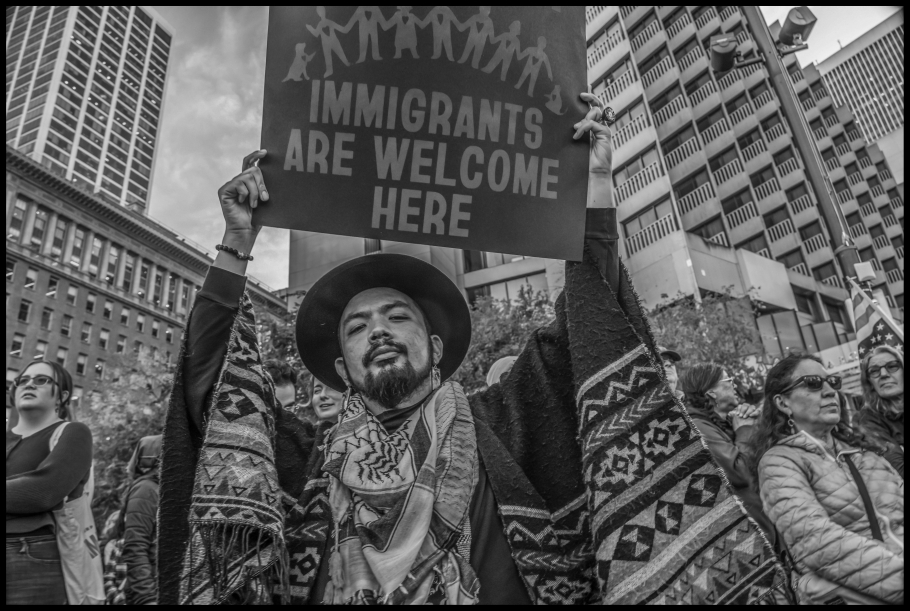
Later in the day, several thousand people came together in front of the Ferry Building, on San Francisco's Embarcadero, in a flash rally organized a day earlier by Bay Resistance, a coalition of organizations protesting immigration raids. Earlier Mayor Lurie and President Trump announced an agreement, brokered by tech billionaires, to spare the city from the deployment of National Guard troops.
Nevertheless, city supervisors denounced the Mayor for agreeing that Federal agencies would ramp up other enforcement activities in San Francisco. Oakland, where the morning's confrontation had taken place, was not included in the negotiations between Lurie and Trump. David Huerta, president of United Service Workers West, who was manhandled and arrested in Los Angeles protests, called for uniting all of California to resist immigration raids and any use of Federal troops.
The day of protest ended with a march from the Embarcadero to the building housing the immigration courts, where numerous people have been seized by Federal agents as they appear for hearings on their applications for residence and asylum.
But except for their half-dozen SUVs and king cab pickups, no other cars got through. It all reminded me of 1984, when a similar moving line blocked Pier 80 in San Francisco, and longshore workers refused to cross it and unload South African cargo from the Nedlloyd Kimberley. The Bay Area has this rich history of people putting themselves on the line for justice.
To date, no charges have yet been filed against the Border Patrol agent who fired his weapon at Rev. Bautista, and his identity is not known.
dbacon@igc.org
Make Comment/View Comments