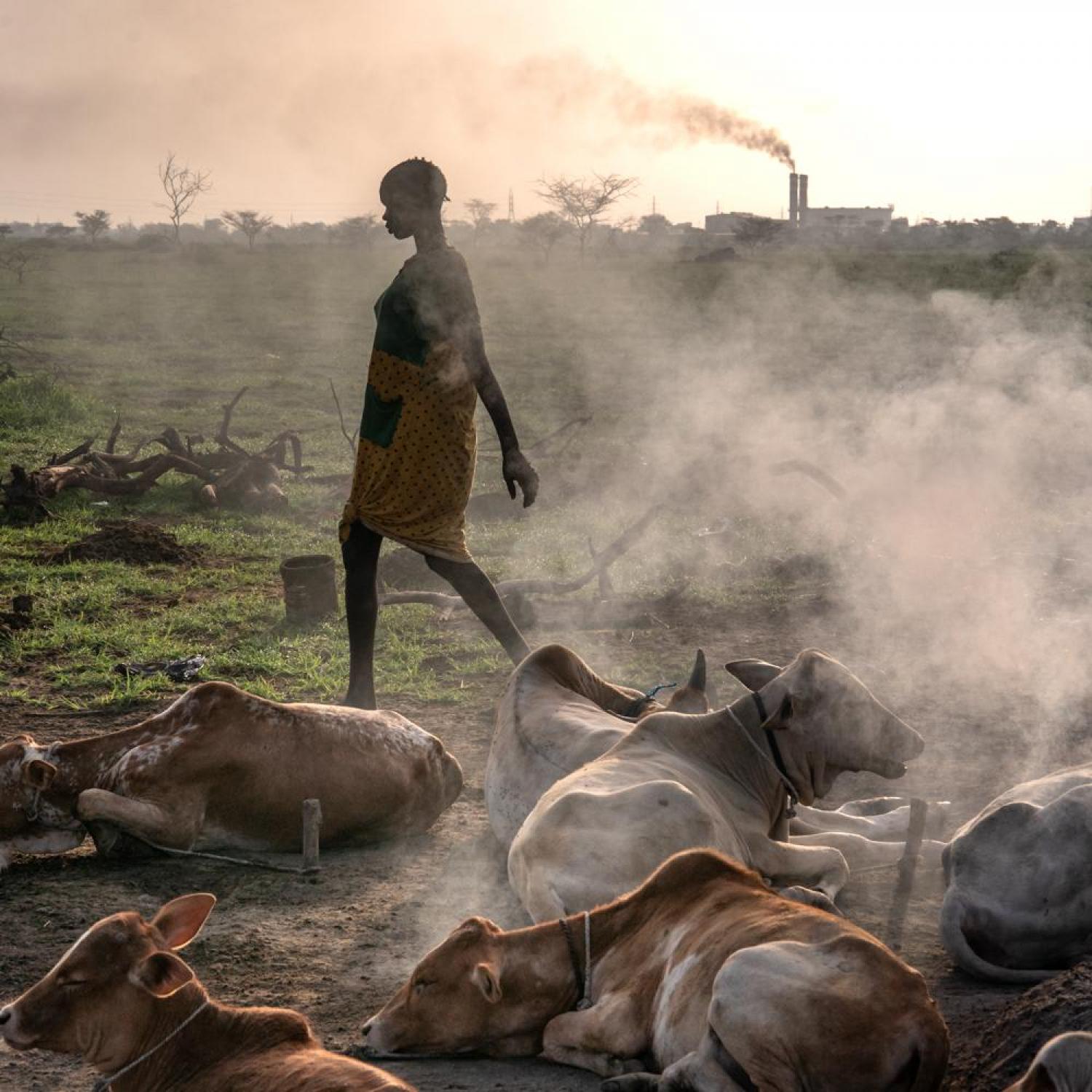

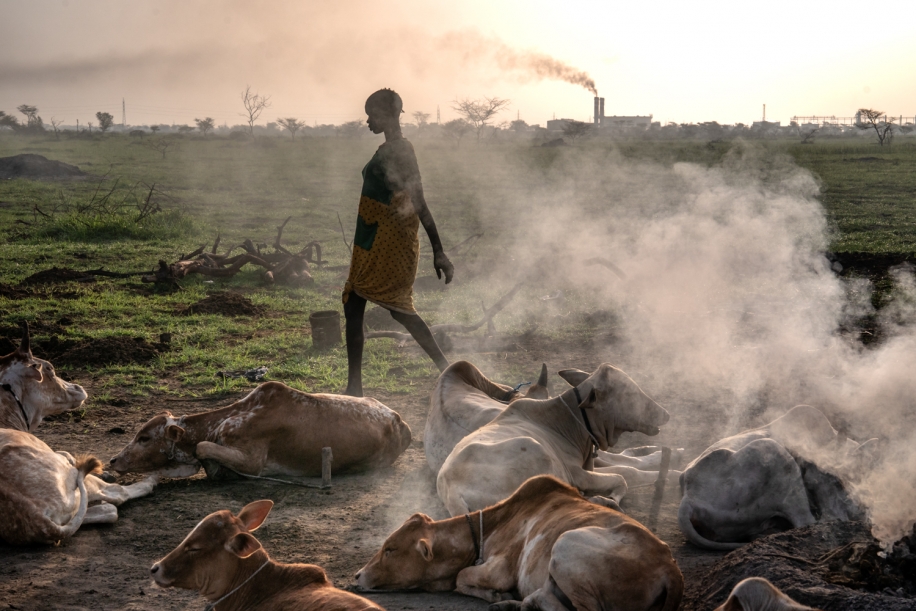

A woman tends to her cattle at dawn at a livestock camp outside Rier village, Koch County, Unity State, South Sudan, on June 4, 2025, with an oil production facility visible in the distance. Herders in the area say their livestock have suffered unexplained illnesses, deformities, and sudden deaths, and that members of their families have also experienced illness, which they attribute to drinking from water sources near oil infrastructure.
Between Oil and Water
Diana Zeyneb Alhindawi | Koch county, Unity state, South Sudan
Photographer: Diana Zeyneb Alhindawi
Exhibit Title: Between Oil and Water
Location: Koch county, Unity state, South Sudan
In Koch County, South Sudan, communities living near oil production facilities report a rise in congenital disease that they link to water contamination. With few functioning boreholes, families rely on ponds, canals, and seasonal floodplains for drinking, cooking, and washing. The oil fields generate “produced water,” a toxic byproduct of extraction containing salts, heavy metals, and chemical additives. During the rainy season, this wastewater can spread across fields and waterways; in the dry season, it can seep into soil and groundwater.
Residents describe livestock deaths, chronic illness, miscarriages, and children born with severe impairments, including missing eyes, malformed limbs, and neurological damage. Laboratory testing of local water found elevated levels of aluminum, potassium, sodium, and traces of lead, substances that pose serious risks during pregnancy. Clean water remains scarce, and health facilities are under-resourced or closed.
The oil fields were long operated by a consortium led by Malaysian state-owned PETRONAS, through its local operator, Sudd Petroleum Operating Company. When concerns reached company leadership and business partners, including Mercedes-Benz, meetings were held and assurances were made, but no comprehensive cleanup or long-term health response followed.
All images credit: Diana Zeyneb Alhindawi/Bloomberg
This work was undertaken on assignment for Bloomberg.
Diana Zeyneb Alhindawi is a Brooklyn-based Romanian-Iraqi photographer whose work explores the human condition in contexts of conflict, humanitarian crisis, and social upheaval. Her photography has been featured by The New York Times, The Wall Street Journal, The Washington Post, and Le Monde, as well as by organizations including Doctors Without Borders and UNICEF. Her awards include LensCulture's Top 50 Emerging Talents (2014), the ICRC Humanitarian Visa d'Or Award (2015), PDN's 30 New and Emerging Photographers to Watch (2018), and American Photography/AP41 (2025).
Born in rural Romania to a Romanian mother and Iraqi father, Alhindawi experienced displacement early in life when her family became refugees, first in the former Yugoslavia and later resettling in Canada. These formative experiences led her to work in humanitarian aid and human rights, holding management and research roles with organizations such as the United Nations Development Programme, Save the Children, and Oxfam in conflict- and disaster-affected regions. In 2013, she shifted her professional focus to photography.
Alhindawi holds a BA in Economics and a BA in Neuroscience from Johns Hopkins University and has completed all but her thesis for an MA in International Development. She speaks English, French, Spanish, and Romanian.
Email: dalhindawi@gmail.com
IG: @dianazeynebalhindawi

Make Comment/View Comments