


The Mohana: A People Adrift
Guillaume Petermann | Pakistan
Photographer: Guillaume Petermann
Exhibit Title: The Mohana: A People Adrift
Location: Pakistan
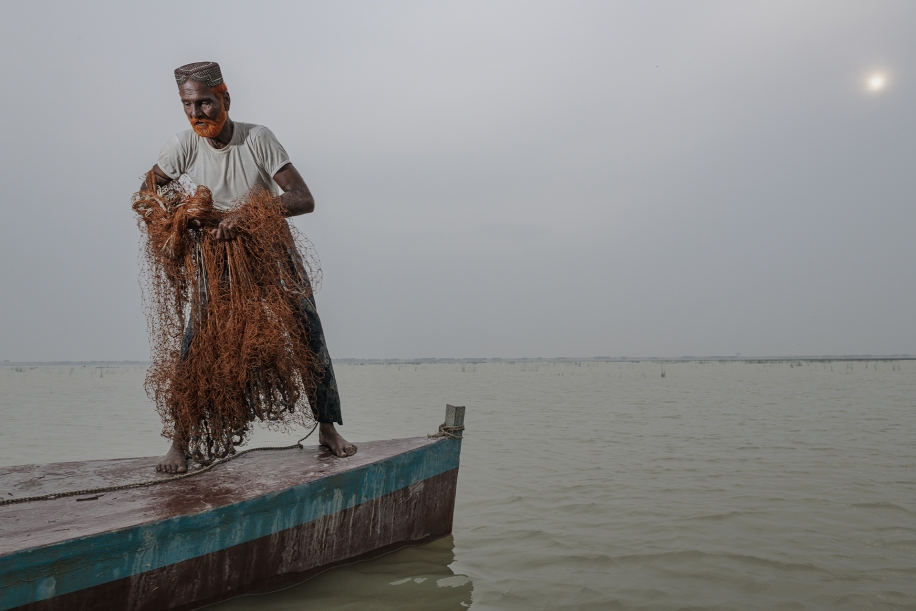
This is the story of a slow disappearance: that of the Mohana, a fishing community that has lived for generations on Lake Manchar in southern Pakistan. This lake, the largest in the country, was once a nourishing and sacred ecosystem. But now this sanctuary is dying under decades of pollution and reduced freshwater inflow. A canal built in the 1990s channelled agricultural runoff, industrial effluents and urban sewage directly into the lake. Climate change and upstream dams have accelerated the ecological breakdown.
Once a nomadic people, the Mohana—descendants of the first peoples of the Indus Valley—lived on floating dwellings called Galiyo, drawing their food, water and identity from the lake. Fish were abundant, and migratory birds shared the wetlands with them. Today, both have nearly vanished. With no fish and no clean water, most Mohana have been forced onto the shores, surviving in fragile shelters along the brackish water while poverty spreads.
As younger generations turn to other aspirations, their culture erodes. Through this series, the fate of the Mohana becomes a larger question: what becomes of a culture when the environment that shaped it disappears?
This is the story of a slow disappearance: that of the Mohana, a fishing community that has lived for generations in harmony with Lake Manchar, in southern Pakistan. This vast freshwater expanse, covering nearly 250 km² and the largest in the country, has long been an oasis of life, a unique, nourishing and sacred ecosystem. But this natural sanctuary is dying. And with it, a whole world shaped by its water is sinking.
Descendants of the first peoples of the Indus Valley, the Mohana are the heirs to a 5,000-year-old civilisation. Their heritage, inseparable from the waters of Lake Manchar, has endured through the ages. But today, their unique, centuries-old way of life is on the verge of disappearing forever.
Lake Manchar was once a natural sanctuary where humans and nature flourished together. Fish were abundant and migratory birds flocked there from distant lands. But in the 1990s, a canal was built, initially intended to drain saline water from agricultural land. In reality, it redirected agricultural wastewater, full of fertilisers and pesticides, as well as industrial effluents and sewage from several large cities in the province, directly into the lake.
Within a few decades, Manchar’s fragile ecosystem collapsed. Climate change has only accelerated the disaster: declining rainfall, combined with the construction of two dams upstream on the Indus River, has drastically reduced the flow of fresh water into the lake.
Once a nomadic people, the Mohana lived exclusively on typical floating dwellings called Galiyo. They had a deep spiritual connection with their environment. Their lives, beliefs and social bonds were all shaped by the water that surrounded them. They drank from the lake, fished its depths, and their thriving catches fed the entire region.
Today, the fish have nearly vanished, and with them the migratory birds, the Mohana's long-time companions, with whom they have a unique relationship. The entire balance of biodiversity has been disrupted. And with it, an entire culture has been left adrift on a lake that is now nothing more than a mirage of what it once was.
Deprived of fish and clean water, most of the Mohana have been forced ashore like wreckage. They now live on the shores of the lake, in makeshift shelters made of reeds, tarpaulins and scrap materials lining the brackish water. Here, disease spreads, poverty is rampant, and the last remaining fishermen struggle to catch the few fish that can survive in the polluted waters.
As Mohana children learn other languages, other trades and other dreams, their culture is slowly dying out, and with it, their way of life. The Mohana, a thousand-year-old people, are seeing their world slowly and inevitably collapse. Their culture is not disappearing all at once: it is fading away in fragments, like a mural flaking away, like a song whose lyrics are gradually forgotten.
Beyond the environmental aspect, this series explores the resilience of a people faced with the impending disappearance of their world and identity. The story of the Mohana, living heirs of the peoples of the Indus Valley, one of humanity's oldest civilisations, raises a global question: what happens to a culture when the environment that shaped it disappears?
Make Comment/View Comments