

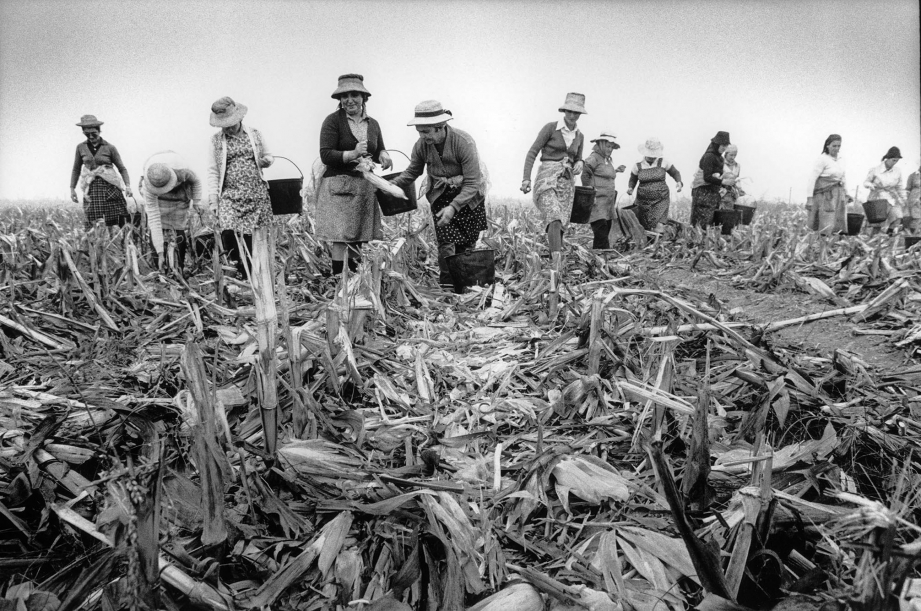

Grass widows: Women harvesting maize (corn) in the Ribatejo. Annual emigration from Portugal rose from 30,000–35,000 in the 1980s to around 110,000 in 2013. Men make up the majority of those leaving. The social effects include an ageing population and a disproportionate number of women. In some areas, villages resemble ghost towns where only women work in the fields. They are called 'grass widows’: their husbands are generally alive but living abroad.
Grass Widows
Jan Banning | Portugal, Alentejo & Ribatejo, Portugal
Photographer: Jan Banning
Exhibit Title: Grass Widows
Location: Portugal, Alentejo & Ribatejo, Portugal
Since the late 1800s, Portugal has been one of Europe's leading emigration countries, with men making up the majority of those leaving. During the 1960s and 1970s, young men also emigrated to avoid conscription for the colonial wars. The 1974 Carnation Revolution and the subsequent collectivisation of latifundias temporarily slowed emigration; it resumed as post-revolutionary disappointment set in. Annual departures rose from 30,000–35,000 in the 1980s to 110,000 in 2013. The social effects include an ageing population and a disproportionate number of women. In some areas, villages resemble ghost towns where only women — 'grass widows' — work in the fields.
Emigration, depopulation and ageing hollowed out formerly left-wing agrarian communities, creating fertile ground for resentment. From 2019, in the former "Red Belt" of the Alentejo, many former PCP voters switched to the far-right Chega. Ironically, while Portuguese emigrated in large numbers, Portugal became a major destination for immigrants. Housing became unaffordable, public services deteriorated, and social tensions grew. Chega exploited this, channelling the growing foreign-born presence into a narrative of the local population becoming a minority in its own land.
Jan Banning is an independent Dutch photographic artist with Dutch East Indies roots. He studied social and economic history. With his book and exhibition Bureaucratics (2008), he gained worldwide recognition. He specializes in documentary series, i.a. Bureaucratics, Comfort Women (2010), Red Utopia (2017), The Verdict: There Christina Boyer Case'(2022), and his latest "Healing Wounds: Reconciliation in Post-Genocide Rwanda.
His work reflects his academic study, focusing on ‘structural,’ socio-political themes. Sometimes, it involves sociological or anthropological classification; at other times, it explores the individual psychological impact of major social events. His roots are evident in projects such as Comfort Women(depicting WWII sex slaves for the Japanese army) and Traces of War (about WWII slave laborers in Southeast Asia).
Banning occasionally describes himself as an ‘artivist,’ not satisfied with merely visualizing themes through documentary work but also striving to bring about change using both his work and his reputation, as exemplified in the case of The Verdict.
His work is held in prominent museum collections, including the High Museum of Art in Atlanta, the Museum of Fine Arts Houston, the Philadelphia Museum of Art and the Rijksmuseum in Amsterdam.
His work has been published in more than a dozen photobooks, and by media such as The Guardian Weekend, Le Monde Magazine, Geo Germany, Internazionale, De Standaard, De Volkskrant.
Jan Banning Fotografie
Begoniastraat 23
3551BJ Utrecht
Netherlands
info@janbanning.com
+31 651 365 983
www.janbanning.com

Make Comment/View Comments