

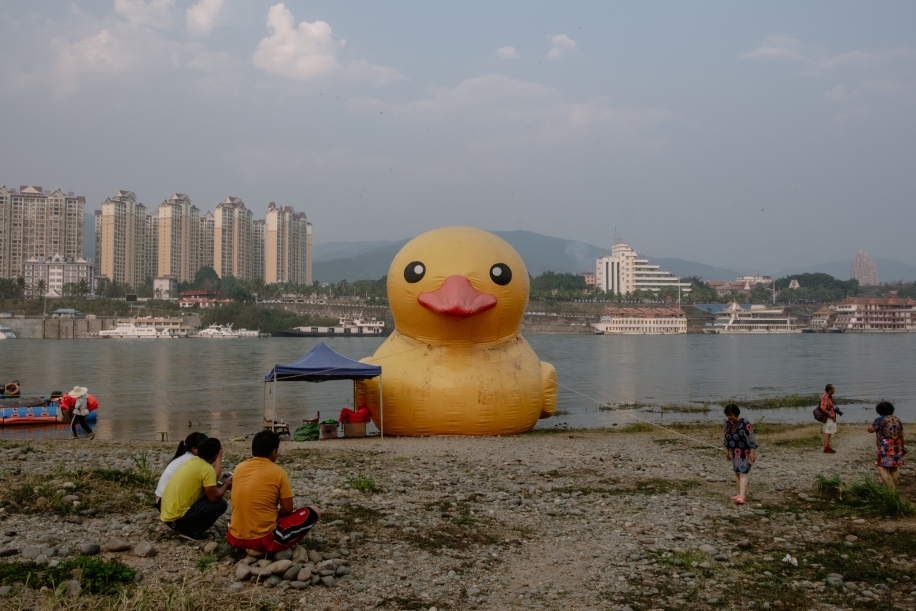

People enjoying the sunny day at the Lancang (Mekong) river in Jinghong. A few kilometers upstream, one of the biggest mainstream dams on Mekong started operating on January 2020. Downstream communities and NGOs denounced huge fluctuations in river levels, disrupting the river's natural cycle
Changing currents: Mekong in transition
Manos Fikaris | Lao People's Democratic Republic
Photographer: Manos Fikaris
Exhibit Title: Changing currents: Mekong in transition
Location: Lao People's Democratic Republic
An estimated 70 million people live along the Mekong River and depend on its natural resources for their livelihoods, food security, and cultural continuity. Fishing and agriculture support both local economies and long-established ways of life throughout the region. In recent decades, large hydroelectric dams built on the Mekong mainstream and its tributaries, together with climate change, pollution, and other human activities, have significantly altered the river’s natural systems.
These changes have resulted in community displacement, disrupted fish migration routes, and increased drought and salinity, affecting agricultural production and river-based practices. As environmental conditions shift, cultural knowledge and traditions connected to the river are also placed at risk. This project examines the social, environmental, and cultural impacts of these transformations, focusing on how large-scale infrastructure and environmental change reshape everyday life along the Mekong. By documenting these processes, the project highlights the challenges faced by river-dependent communities and the ongoing relationship between development, ecosystems, and cultural continuity in the Mekong River basin.
Community participants and local collaborators along the Mekong River
The Mekong is not only a body of water but a shared lifeline for millions of people whose daily lives are shaped by its rhythms. As dams, climate change, and pollution interrupt these rhythms, the river becomes a site of tension between promise and loss.
Through this work, I explore how large-scale human interventions fragment both ecosystems and communities. Disrupted fish migrations, flooded villages, and salinized fields are not abstract consequences of development; they are lived realities that ripple across generations. I am drawn to the quiet, often overlooked moments where environmental transformation intersects with personal experience—where absence, uncertainty, and resilience coexist.
Rather than offering solutions, this project invites reflection on responsibility, power, and coexistence. It asks how progress is measured, who benefits, and who bears the cost. By centering the Mekong and those who depend on it, I aim to create space for empathy, awareness, and a deeper consideration of humanity’s relationship with the natural world.
Field research, interviews, existing reports on the Mekong River, environmental and hydropower data
www.manosfikaris.com
manos.fika@gmail.com
Make Comment/View Comments