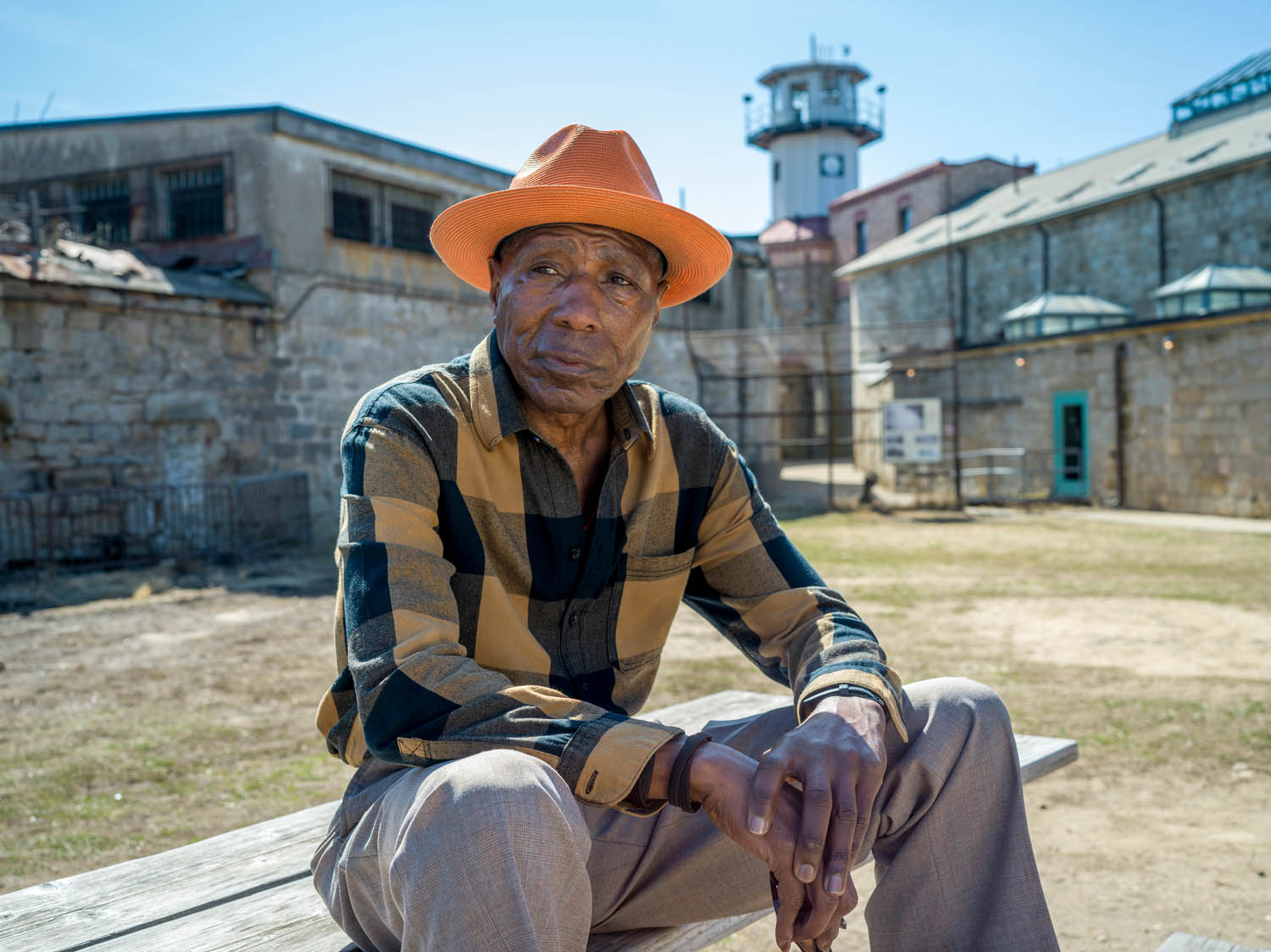

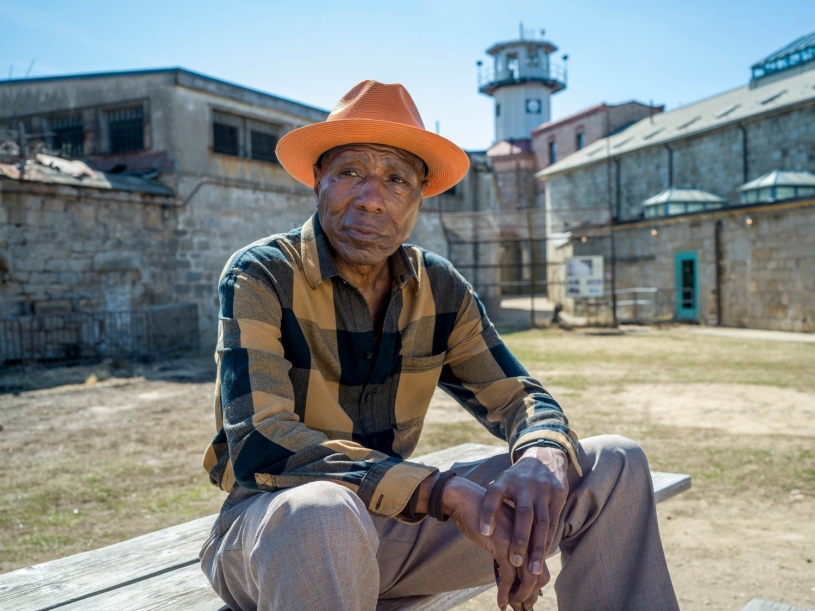

Arthur “Cetewayo” Johnson
Photo by Lori Waselchuk
Arthur “Cetewayo” Johnson spent 51 years in prison on a wrongful conviction — 44 of those years in solitary confinement. He was arrested for murder in 1970, just after turning 18. The case against him relied on a coerced statement from a 15-year-old boy interrogated by police for 21 hours and a “confession” he was manipulated into signing that he was unable to understand because of an intellectual disability and lack of education.“
The hole was brutal,” he says. “We were kept in filthy cells. One pair of boxers, one t-shirt, a toothbrush with the handle cut off. You couldn’t have books, newspapers — only a pen and ten sheets of paper. I was hungry every day. Starvation diets were part of the punishment.”
Guards beat people without cause. Johnson tried to file legal complaints, but the courts denied them, and his letters were often destroyed. His persistence made him a target.
In 2016, the Abolitionist Law Center filed for relief, citing a psychiatrist’s testimony that Johnson had experienced “social death.” The Department of Corrections fought to keep him in isolation, but the judge ruled in Johnson’s favor. He was moved into a step-down unit and eventually returned to general population.
The Abolitionist Law Center then began investigating his original conviction. They uncovered withheld evidence and a coerced, retracted witness statement. Working with the Philadelphia DA’s office, they secured his release in 2021.
Cetewayo lives up to the nickname, which comes from a Zulu leader in recognition of his strength, and he continues to fight for vindication for those who are wrongfully imprisoned. “There’s still so many innocent people inside. I want to help them come home.”
Window Into Solitary
Social Documentary Network | United States
Photographer: Social Documentary Network
Exhibit Title: Window Into Solitary
Location: United States
Window into Solitary is a photography exhibition with the goal to educate and activate the public about the profound impact and harrowing consequences of the widespread use of solitary confinement in American prisons. The project is in conjunction with the publication of Ending Isolation: The Case Against Solitary Confinement, a new book by Christopher Blackwell, Prof. Deborah Zalesne, Kwaneta Harris, and Dr. Terry Kupers exposing the cruel and unusual punishment experienced by close to 125,000 of our fellow citizens each day inside prisons across America.
The exhibit focuses on 17 formerly incarcerated people from across the U.S. who have spent extensive amounts of time in solitary. In addition to powerful photographic images, the exhibit will include written testimony by the participants about their experiences in solitary confinement and their thoughts about its widespread use across the U.S. carceral system.
Photographers
Lori Waselchuk, Philadelphia
Brian Branch-Price, New York
Brian Frank, San Francisco
Deborah Espinosa, Seattle
Produced by:
Look2Justice
Social Documentary Network/ZEKE Magazine
Lori Waselchuk
Lori Waselchuk is a photographer, filmmaker, curator, and socially engaged artist. Her artistic practice is rooted in community, the possibilities, the tensions and challenges of working together for a common idea or good.
Past collaborative projects include Grace Before Dying, about a hospice program in the Louisiana State Penitentiary, where both the caregivers and the patients are serving long-term prison sentences.
Lori is also a curator and coordinator of numerous exhibition projects including the Women’s Mobile Museum, co-created with Zanele Muholi, and produced by TILT Institute for the Contemporary Image. Lori is the recipient of Leeway Foundation’s Media Artist & Activist Residency and the Transformation Award, Velocity Fund Grant, Pew Fellowship for the Arts, Aaron Siskind Foundation’s Individual Photographer, and the Southern African Gender and Media Award. Her projects have been exhibited in Africa, South America, North America and Europe and her work is published widely in books and publications.
Lori is currently the curator-in-residence at the Writers Room in Philadelphia and the director-producer of the upcoming film series, Abolition Conversations.
Deborah Espinosa
Deborah Espinosa is an attorney-at-law and an artist at heart. She combines her legal and multimedia storytelling skills to advocate for the rights of people from poor and marginalized communities, in both the United States and African countries. She knows that collaborative storytelling is the most compelling and impactful advocacy tool for reform of unjust law.
Deborah is former staff attorney and staff photographer for the international NGO Landesa. She is a member of the inaugural cohort of We, Women, a project of women and gender-nonconforming artists whose photo practice is grounded in collaboration and community engagement. She turned her personal photography project, Living with Conviction: Sentenced to Debt for Life in Washington State into a nonprofit organization that is leading a movement to equip and empower people to know, use, and shape their post-conviction rights. Community-driven storytelling is core to Living with Conviction’s mission to secure economic and racial justice with and for marginalized communities.
Deborah was born and raised in southern California to a Mexican father and Norwegian mother. She currently lives in Seattle, Washington.
Brian Branch-Price
Brian Branch-Price is a native of Plainfield, New Jersey and a Howard University graduate with a degree in geology and fine arts photography. He is a photographer and photo editor whose career has ranged from photojournalism to commissioned fine arts projects.
His career as a photojournalist began at The Hilltop (Howard University) as well as a freelancer for The Washington Post. He had five photo internships before staffing for the Trenton Times, The New Journal, the Associated Press, Public Square Amplified and Zuma Press.
Brian was selected as a DOD Embed for the Iraq War for AP. His work includes reportage on Obataan Mobilization Against Poverty, an orphanage in Ghana, January 6 riots, Super Bowl, World Series, and world cycling championships.
His current project, “The Original Cowboy, An American Institution,” takes a deep look into the Black cowboy culture. Other projects include Black maternal health and infant mortality, vanishing communities, Major Taylor Legacies, BLM, and Black Gospel legends.
Brian Frank
Brian Frank documents cultural identity, social inequality, violence, workers’ rights, and the environment across the Americas.
Recently, Brian received a For Freedoms/National Geographic grant to work on faith and labor among California Central Valley migrant workers. He is a Journalism Professor and a Catchlight Global Fellow. His work with Catchlight, the Pulitzer Center, and the Marshall Project documents mass incarceration and develops visual education programs in juvenile centers and impacted communities.
He has led visual storytelling workshops for educators, journalists, and youth across the U.S. and Mexico and lectured on visual curricula at universities, including Harvard.
His two-year project, Downstream, Death of the Colorado, is in the collection of the United States Library of Congress and won POYi’s Global Vision Award. La Guerra Mexicana, a project on Mexico’s violence and drug war, won NPPA’s Domestic News Picture Story of the Year. His work has appeared in publications nationwide.
After graduating from SFSU’s Journalism program, Brian worked for The Wall Street Journal and now focuses on documentary work in California, the Southwest, and Mexico.
Make Comment/View Comments