

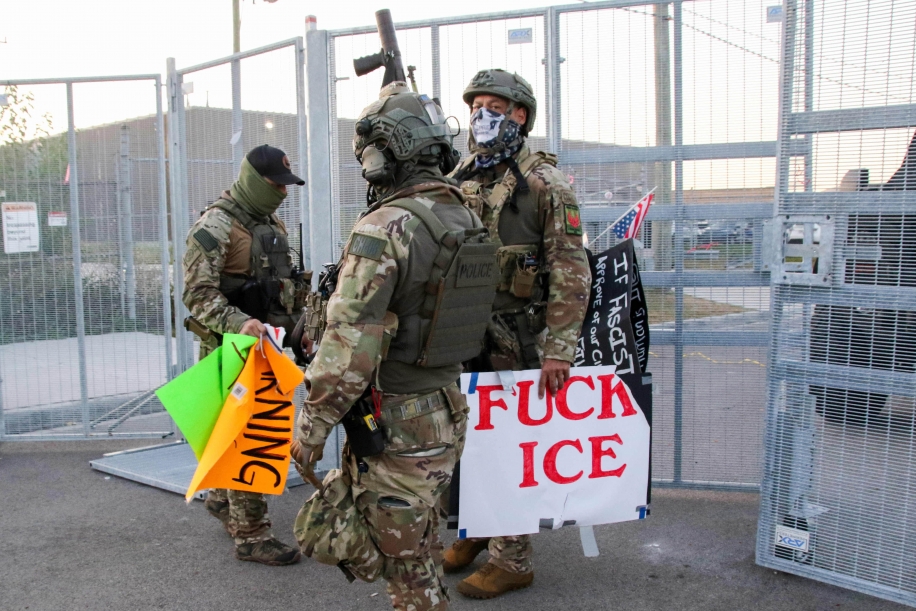

A few armed federal agents remove the posters put up on the front of the fencing surrounding the front entrance of the ICE detention facility on Beach Street in Broadview, IL. For the fourth Friday in a row, protesters have returned to this facility to attempt to block operations tied to enforcement sweeps.
Broadview’s Stand
alexandra buxbaum | Illinois, United States
Photographer: alexandra buxbaum
Exhibit Title: Broadview’s Stand
Location: Illinois, United States
On September 9, 2025, President Trump launched Operation Midway Blitz, a federal crackdown on undocumented immigrants in Chicago that expanded across Illinois and into Lake County, Indiana. Led by ICE, the operation w target undocumented individuals, Its epicenter became the ICE Processing Facility in Broadview, a village of under 8,000 residents west of Chicago.
The facility drew weekly protests, which intensified after ICE fatally shot Silverio Villegas-Gonzalez on September 12. Clergy, activists, and community members converged, and clashes escalated. Federal agents used tear gas and pepper bullets, some fired from rooftops, against protesters and journalists.
In response, Broadview Mayor Katrina Thompson issued an executive order limiting protest hours to 9AM–6PM and installed concrete barriers to create “safety zones.” By October, Broadview police coordinated with state troopers and sheriff’s deputies to enforce restrictions and maintain access to the facility.
Mayor Thompson publicly condemned ICE, urging it to “stop making war” in her town. Meanwhile, the Chicago News Guild, joined by clergy and journalists, filed a federal lawsuit accusing ICE of violating First Amendment protections through a “pattern of brutality.”
I arrived at Broadview not merely as a photographer, but as a witness to a dark, historical event taking place in real time.
I was a witness to state brutality and unchecked power; the militarization of ICE with military-style tactics, deploying riot control agents banned for use in actual war zones. Each frame I captured is a testament to the tension between state power and public dissent. The concrete barriers, the police presence, the less-lethal weapons were not abstractions but the architecture of suppression. Yet amid the chaos, I saw bravery in those showing up and willing to take a stand; the faces of those who refused to be silenced, even when tear gas burned their eyes and rubber bullets wounded their flesh.
Photography in moments like these is not passive. It is a form of testimony. I offer these images not merely as historical record, but as proof that those at protesters at Broadview stood up and took a stand no matter the personal cost.
abuxbaum@documentaryarts.com
Make Comment/View Comments