

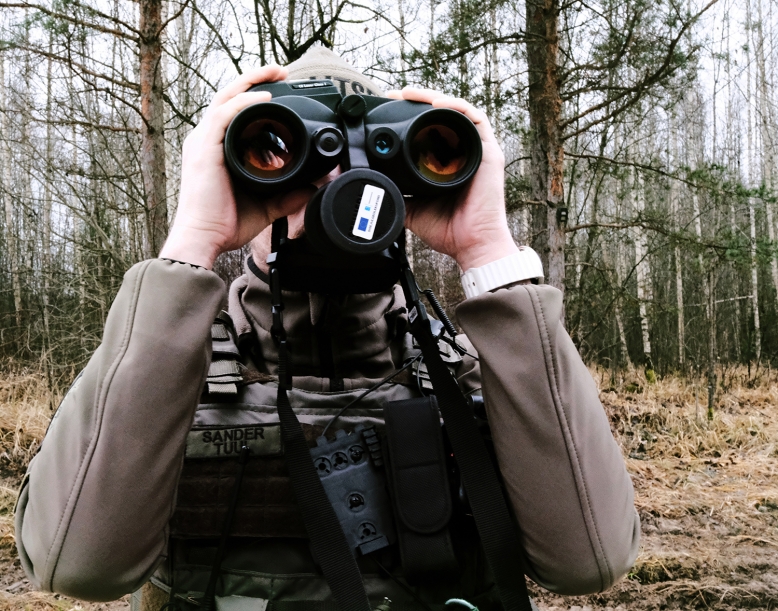

A border guard surveys the Saatse area through his binoculars, a sector that has become particularly sensitive since controls were tightened in 2022. Here, the frontier cuts through the landscape in irregular lines and small enclaves, making patrols unusually complex: in some places, only a few metres separate Estonian roads from Russian territory.
Last stop before Moscow
Photographer: Aude Osnowycz
Exhibit Title: Last stop before Moscow
Location: Estonia
Last Stop Before Moscow is a photographic project developed in Estonia, along its border with Russia.
Since the war in Ukraine, this region has drawn increased international attention. Fears of invasion and destabilisation, of Estonia and of Europe, have returned this border to the center of strategic concern.
Here, the border is not an abstract line. It runs alongside apartment blocks and through forests. In Narva and Ida-Viru region, the population is almost entirely Russian-speaking. Language, Soviet memory, and Russian influence remain deeply rooted, reinforced by propaganda since the conflict began.
At the same time, the younger generation looks elsewhere. Russian-speaking by heritage, many turn toward the West, to Tallinn, education, mobility and creative paths. Their outlook moves away from Moscow. Without rejecting their family history, they search for a different future, often drawing their parents into this slow shift.
Further south, in Setomaa, the border cuts an ancient territory in two. Since 2022, stricter controls have made crossings rare, leaving families separated and traditions under strain.
Through portraits and landscapes, this project follows ordinary lives at a transition moment within a rapidly shifting borderland.
Aude Osnowycz is a documentary photographer and writer based in France. Her work develops through long-term projects focused on territories shaped by history, borders, and political oppression. She works primarily in post-Soviet spaces and Eastern Europe, where geopolitical transformations are not abstract concepts but lived realities embedded in everyday life.
Her practice is deeply informed by a family history marked by dictatorship, political violence, and exile. The memory of her grandfather, who lived under authoritarian regimes in the twentieth century, forms a key starting point of her work: an attempt to understand how individuals endure, resist, or adapt when oppression becomes part of daily life, and how these experiences are transmitted across generations.
Through portraiture, landscape, and narrative devices such as diptychs, she explores forms of dissent—both visible and discreet—and the tensions between loyalty, fear, and freedom. Her projects focus on in-between situations: living on a border, inhabiting a country without fully adhering to its dominant narrative, remaining when leaving is impossible or undesired. Particular attention is given to women, who are often central to networks of resistance, care, and transmission under authoritarian systems.
Her work favors immersion, a restrained visual language, and close attention to everyday gestures, bodies, silences, and relationships. Rather than documenting spectacular events or the collapse of regimes, she examines the long-term effects of oppression on individual lives—what it constrains, what it fractures, and what it ultimately fails to erase.
www.audeosnowycz.photoshelter.com
Make Comment/View Comments