

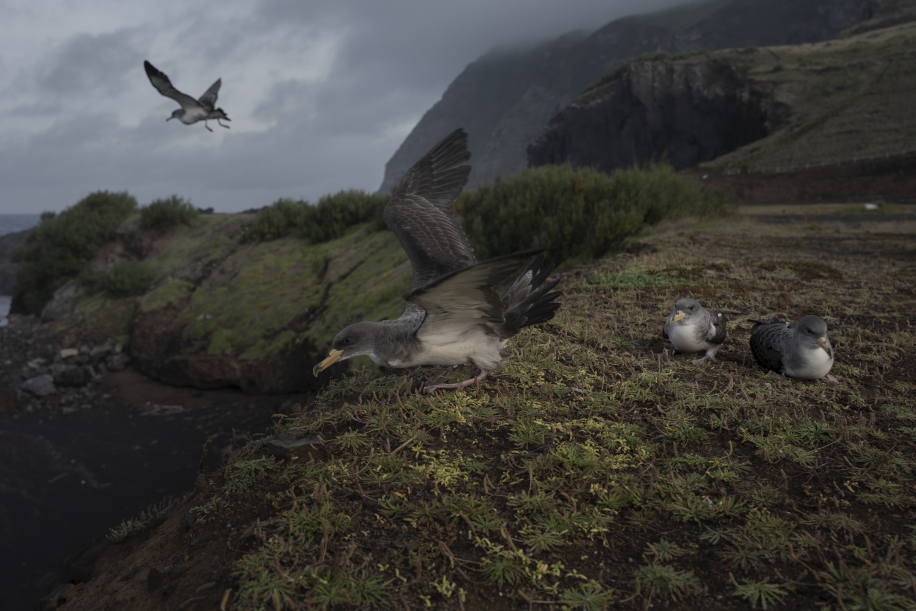

At the time of departure toward the ocean, chicks are often heavier than the adults, having spent around three months in the nest, fed at night by parents returning from long foraging trips at sea. As those visits grow less frequent, the young bird builds the reserves and strength it needs. Within a few weeks, it will slim down to a more efficient flight weight, helping it learn to fly and hunt. Corvo Island, 2025
The Second First Flight - How a remote island fights light pollution to let life take flight
Andrea Domenico Zanenga | Portugal
Photographer: Andrea Domenico Zanenga
Exhibit Title: The Second First Flight - How a remote island fights light pollution to let life take flight
Location: Portugal
On Corvo Island, in the Atlantic Ocean, a community of 450 inhabitants fights light pollution to protect wildlife. The story began in 1991, when residents noticed that artificial lights were killing Cory's Shearwaters, endemic seabirds that, after three months in their nests, attempt their first flight by the stars. Disoriented by streetlights, many crashed into the village streets.
Moved by love for these birds, the community began rescuing them at night. This inspired the Azorean Government to launch the SOS Cagarros campaign in 1995 across all nine islands, later supported by SPEA (Portuguese Society for the Study of Birds).
Corvo holds a unique role: since 2019, it is the only island that performs a full public lighting blackout every autumn for five nights. The island surrenders to darkness, returning the stars to the sky, while adults and children walk through the village to rescue fallen birds. Recovered overnight in cardboard boxes, they are released the following day close to the ocean.
Since 2015, more than 30,000 fledglings have been rescued across the Azores a proof that small actions can restore ecological balance and inspire coexistence with nature.
I was born and I live in the Po Valley, Italy, the most light-polluted region in Europe, where the night sky is no longer visible. Here, over 75% of the population has never seen the Milky Way, and more than 90% of the stars remain hidden by artificial glow.
This fact has shaped in my mind the idea that light pollution disconnects us from
nature and distorts our relationship with the cosmos, creating a distance between us and our consciousness as we live on this planet.
This project is both a personal journey and a call to action. Documenting Corvo’s
collective effort to embrace darkness is not only a conservation story; it is a reflection on how we might restore our sensory and ecological connection to the world around us and inspire change for other populations and collectives on the planet.
SPEA: Portuguese Society for the Study of Birds
andreadomenicozanenga@gmail.com
+39 3791569081
Instagram @andreazanenga

Make Comment/View Comments