

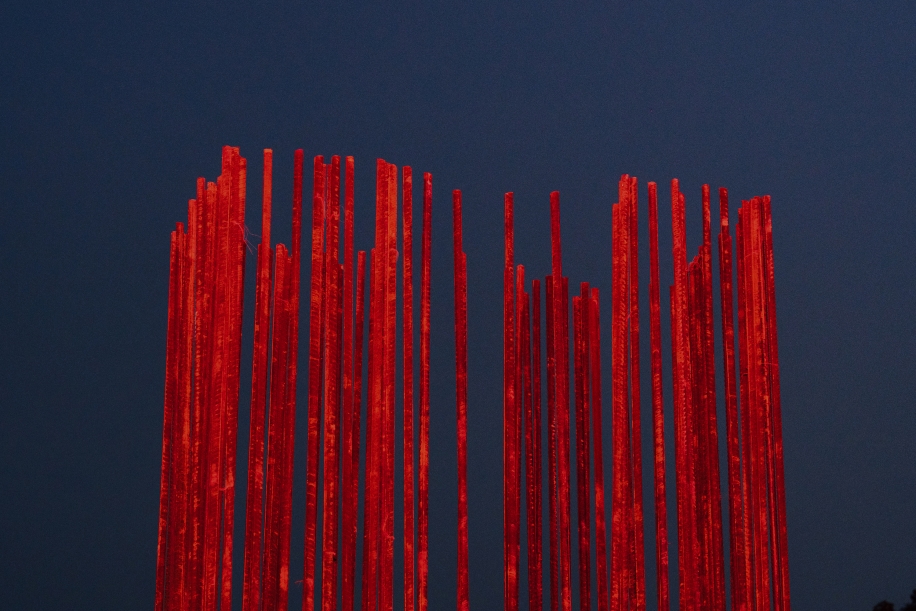

The Place Where I Used To Play...
Jubair Ahmed Arnob | Bangladesh
Photographer: Jubair Ahmed Arnob
Exhibit Title: The Place Where I Used To Play...
Location: Bangladesh
This project documents the transformation of Green Model Town, a peripheral neighborhood in Dhaka, Bangladesh, once shaped by rivers, trees, and shared community life, now rapidly erased by unchecked urbanization. Through long-term, site-responsive visual storytelling, I examine how development replaces natural and social ecosystems with dense, fragile infrastructure.
Dhaka—one of the fastest-growing megacities in the world—absorbs millions driven by climate displacement and economic migration, intensifying environmental loss and everyday risk in a city built largely without regulation. Over three years of self-funded work, I have returned repeatedly to the same spaces, photographing not only what is constructed, but what disappears.
Working as both participant and witness, my surreal, memory-driven approach evokes absence and emotional rupture, revealing the human and ecological costs of urban growth and questioning how cities might develop without erasing what once made them livable.
“What is the city but the people?” — William Shakespeare
I often return, in memory, to Green Model Town, on the edge of Dhaka, Bangladesh—where I once swam in a canal flowing into the Balu River, and we played beneath wide trees, our laughter echoing across open fields. Today, the river is reduced to a cracked canal, the fields buried under concrete, and the trees—the silent witnesses of my childhood—have nearly vanished.
Urbanization is global, yet Dhaka’s transformation is a striking example of human and environmental cost. With a population now surpassing 23 million, packed into just 306 square kilometers, it is the world’s 4th most populous city, expanding at nearly 4.2% annually— more than twice the global urbanization rate of 1.8%. Much of this growth is driven by rural displacement—families pushed by rising seas, lost farmland, and climate shocks. This collision results in chaotic, unplanned growth, where profit-driven development displaces communities and destroys fragile ecosystems.
For the past three years, I have been documenting this transformation as both participant and witness. My dreamy, surreal style evokes loss rather than simply showing it. Alongside images, I collect oral histories, ambient sounds, and fragments of memory—layering voices, water, wind, and silence. This blending of mediums moves beyond fact into felt experience, carrying memory even as the landscape erases it.
Each week, new construction wipes away rivers, trees, and homes. If we do not record these transformations now, they will exist only in memory. My work asks: What does development mean if it erases joy, belonging, and connection to nature? What do people carry forward when their landscapes disappear?
To me, photography is an act of moral witnessing. This project is not only about Dhaka, but also about every city racing toward the same uncertain future.
Contact Number: +8801758975054
E-Mail: arnobofficial.photography@gmail.com
Instagram: https://www.instagram.com/arnob_jubair_photography/

Make Comment/View Comments