See me, I am here
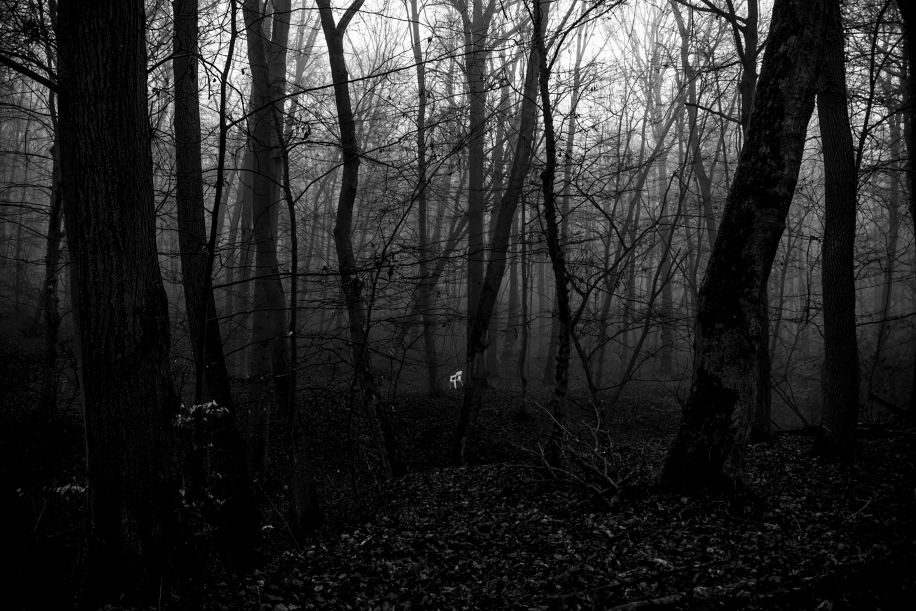
A single white chair sits in the forest of Isserstedt, a village near Jena in eastern Germany. It invites pause — not for comfort, but for confrontation. The chair is unassuming, yet it carries weight. It marks a presence in a place shaped by absence: absence of dialogue, absence of historical accountability.
This forest is not just any forest. It is the one I grew up with, only a few meters from my parents’ house — a place of childhood wonder and quiet refuge. We played football on a nearby pitch, rode bicycles in summer, sledded in winter, and built forts under the trees. To us, the woods felt untouched by politics or pain. But the forest was never neutral. Even then, it held the echoes of a divided nation.
Isserstedt lies in Thuringia, once part of the German Democratic Republic (GDR). After the fall of the Berlin Wall, the forest — like the country — entered a period of transition. Soviet tanks still rumbled through in the mid-1990s, a lingering reminder of ideological rigidity. The silence that followed was not peace but disorientation. The promises of liberal democracy arrived unevenly, leaving economic disparity, cultural marginalization, and a sense of betrayal in their wake.
Today, the forest carries another kind of tension. Thuringia is a stronghold of the far-right party Alternative für Deutschland (AfD). Its rise is not an anomaly but a symptom of deeper fractures — communities that feel unseen and unrepresented. It also reflects the persistence of whiteness as an unexamined norm, and the refusal to confront the legacies of racism that shape everyday life.
The chair in the forest is not neutral. It asks viewers to sit with discomfort, to reflect on privilege and the systems that sustain it. In this forest, whiteness is not just a demographic fact but a historical construct — embedded in the soil of post-reunification Germany, in school curricula, and in the silences surrounding conversations about race.
In school, racism was taught mainly through the lens of National Socialism. The Holocaust was rightly central, but it was presented as an aberration — a dark chapter that had been closed. Colonialism was barely mentioned. Germany’s role in Namibia, the genocide of the Herero and Nama, the racial science that shaped European anthropology — these were absent. Racism was framed as loud, historical, foreign. Not as something quiet, systemic, and ongoing.
This absence matters. It reinforces the idea that racism is only visible when violent, that whiteness is neutral, and that Blackness is always marked. It leaves little room for complexity, for nuance, for listening.
Isserstedt’s forest is a witness to layered histories: the rigidity of the GDR, the disorientation of reunification, and now the resurgence of nationalism. After 1989, many in the East felt abandoned. The West arrived with institutions and values — but not always with empathy. The collapse of state industries, the loss of social cohesion, and the dominance of Western narratives created fertile ground for resentment. Into that resentment, nationalism crept. And of course, racism is not confined to the East. It runs through every sphere of life, across Germany, across Europe, across the world.
Racist violence after reunification has been sustained: from the arson attacks in Rostock-Lichtenhagen in 1992 to the NSU murders that targeted Turkish and Kurdish communities. Denial has been just as persistent. In Thuringia, where the NSU operated for years, authorities repeatedly failed to investigate racism as a motive — a structural blindness rooted in the refusal to see whiteness as power.
Racism here is not always loud. It is quiet. It is in the way people look at Kavoy when he walks through the village. It is in the questions — “Where are you really from?” — and in the silences. It is in the refusal to see whiteness as something constructed, inherited, and powerful.
Decolonial thought urges us to interrogate inherited narratives, to recognize how colonial ideologies shaped the foundations of Europe: through classification, conquest, and the construction of the Other. The forest becomes a space of confrontation. It carries the echoes of racial science once legitimized by German anthropologists, the silence of school curricula that restrict racism to Nazism, and the possibility of dialogue — if we are willing to listen.
The flickering candle honors Black people who have experienced racist violence in Germany. It remembers lives like Lorenz A., a 21-year-old Afro-German man fatally shot by police in Oldenburg in 2025. His death sparked protests and renewed calls to confront racial bias in law enforcement — a bias that continues to cost lives. It also remembers Nelson, a 15-year-old Black boy who allegedly died by suicide in a juvenile detention center after alleged abuse by staff. His story, too, reveals how systemic neglect and racialized violence operate quietly within institutions meant to protect.
This essay is not an indictment. It is an invitation. To sit in the chair. To walk the foggy path. To dwell in the forest not as a place of escape, but as a site of memory, of confrontation, and of care.
Kavoy’s presence in these images is not performative. It is declarative. It says: I am here. I read here. I think here. I am. His gestures — sitting calmly, walking deliberately, reading with focus — are not just acts of comfort. They are acts of belonging. They say: I am part of this place. I claim it without apology. In a landscape where Black bodies are often seen as out of place, his presence redefines the space. It challenges the quiet codes of exclusion and rewrites them with dignity. Imagination is what transforms physical spaces and surroundings, as well as how people feel within them.