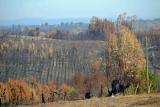
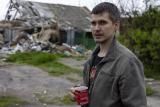
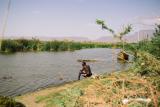
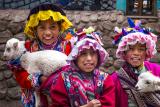
Captions by William deBuys


In March of 2009 I traveled with writer William deBuys (who wrote these captions) to the Lamandau River Wildlife Reserve in Central Kalimantan, Indonesia. This fifty-four thousand- hectare reserve on the island of Borneo is the site of an upcoming Rare Pride campaign focused on protecting orangutans by breaking the cycle of deforestation that is destroying their habitat. This is also a site where Rare is beginning to test how to bring forest conservation into the rapidly developing global carbon market, a critical weapon in the fight against climate change. Through the stories of the individuals in these pages, Bill and I are documenting examples of the complex, multi-faceted dynamics on the ground that challenge conventional wisdom about international conservation. It is increasingly apparent that effective conservation must seek to do much more than sustain biodiversity and habitat; it must also consider the lives of the people who live in and depend on these places. Those in the developed world who support tropical conservation must recognize the challenges and understand the hopes of the people who call the tropics home. If conservation can empower them to be active participants—even leaders—in shaping their own futures, we will be helping ensure not only that conservation goals are achieved, but also that they are sustained. In 2008 the Guinness Book of World Records declared that Indonesia is experiencing the world’s fastest deforestation rate. Borneo alone has lost over fifty percent of its original forest cover; half of that loss occurred in the last twenty years alone. By any measure, deforestation—especially in the species-rich tropics—is a conservation tragedy. Today, that tragedy’s repercussions go far beyond the loss of endemic wildlife and the almost inevitable displacement and impoverishment of local people. Vanishing species leave holes in the web of life that ultimately sustains all humans. Even more disturbing, deforestation arguably causes more damage to the climate than any other human activity on the planet. Stopping deforestation on Borneo and throughout the tropics has become one of the global conservation movement’s top priorities. But deforestation is not a simple problem and there is no simple solution. The social, economic, political, cultural, and environmental variables are different everywhere. In Borneo, questions about whether to conserve forests, burn them for farmland, or log them and plant the land with oil palms are tied up in complex cultural and economic considerations. My first trip to photograph Rare at work took me to the Rio San Juan in southernmost Nicaragua in 2006. Since then I have photographed campaigns in Kenya, Mexico, Belize, Seychelles, and Ecuador. I was drawn to Rare's work because of the organization’s dedication to the local communities that lie in the crux of conservation problems, and because of the way Rare empowers those people to not simply tolerate, but actually become a part of the conservation movement. My experience with Rare in diverse environmental, cultural, and geographic situations has led me to appreciate the intense rigor, extraordinary adaptability, and consistently positive impact this program exhibits around the world. To learn more about Rare’s work, go to www.rareconservation.org.



To license this work for editorial, creative, or other uses, click on the OZMO logo above.
This will take you to the Ozmo website where you can review the cost and license for the photographs in this exhibit.
You will need to create an account with both Amazon payments and with the Ozmo website as described on the Ozmo website.

Unable to load Flash content. The YUI Charts Control requires Flash Player 9.0.45 or higher. You can download the latest version of Flash Player from the
Adobe Flash Player Download Center.
Make Comment/View Comments